
Screen Time for Neurodivergent Kids
A framework for managing screen time with neurodivergent minds
Managing screen time is hard for most families. Surveys in both the United States and Australia consistently show that excessive screen time tops the list of health concerns for parents of younger children. That’s for typically developing kids. If you’re managing screen time with a neurodivergent kid, it’s a completely different story.
And if you’re struggling with this right now, you’re probably blaming yourself.
Many parents tell me they feel genuine guilt or shame over how much time their neurodivergent kids spend on screens and how much energy gets burned in the daily battles around transitions and limits. So here’s some good news, sort of. It’s not really about your parenting style, although there are definitely things you can do differently that will help. What’s really going on is that brain development, uneven psychological growth, and learning differences complicate all of this. When you start to understand why this is happening, you can actually change your approach in ways that benefit your child.
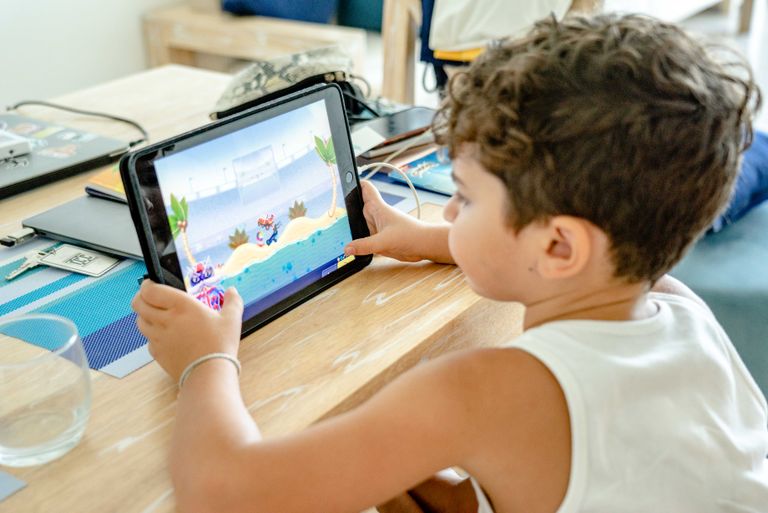
Here’s the pattern I hear over and over from parents of kids with ADHD, autism, learning differences, anxiety, executive function challenges, or depression: Screen time brings calm, focus, and competence. The kids seem happier. There’s less arguing. They’re focused. They often feel better about themselves during that time. But then comes the transition, and everything falls apart. The meltdowns, the arguments, the emotional explosions. You know exactly what I’m talking about if you’ve lived through it.
What parent doesn’t want their kid to be happy? Especially when you’re raising a child who struggles in so many other settings. I get it. But wanting your kid to be happy doesn’t mean giving them ice cream for every meal, and it doesn’t mean unlimited screen access either. The trick is understanding what’s actually happening in your child’s brain and development.
Many neurodivergent kids have brains that are more sensitive to the rewards and predictability of digital environments. They like knowing what’s going to happen. They’re drawn to the immediate payoff of screen-based activities. You’ll often hear this explained through dopamine and neurotransmitter talk, and while the brain chemistry is more complex than a simple shortage story, the lived experience is absolutely real. Screens can feel like a powerful “on switch” for these kids.
At the same time, neurodivergent kids are, by definition, dealing with developmental differences. They’re often less ready to self-manage transitions, tolerate frustration, and handle the delays they encounter in daily life. Not because they’re lazy or oppositional, but because those are the exact skills they’re still building.
At Digitally Nutritious, we look at screen time as a developmental issue, not a moral one. We’re not hunting for the perfect time limit or the one right answer about appropriate content, although I’ll tell you straight up that violent, aggressive, and inappropriate games are even more problematic for neurodivergent kids than typically developing kids. Restrictions matter there.
Our goal isn’t to eliminate every struggle you have with your child about screen time. That’s unrealistic, and honestly, some friction and negotiation is actually helpful for kids. What we want to do is give you a framework that smooths out the worst of it and helps your child become part of the solution rather than the problem. A 30% improvement in daily life—fewer blowups, smoother transitions, better sleep—can genuinely change your household.
Part 1
Why Screen Time Is Different for Neurodivergent Kids
Neurodivergent kids don’t just “like screens.” Many experience screens as uniquely regulating and rewarding in ways that go beyond simple preference.
Digital environments tend to offer something that the rest of life often doesn’t:
Highly structured environments. Clear rules, clear goals. You know what you’re supposed to do and when you’ve done it right.
Immediate reinforcement. Fast feedback, frequent wins. You don’t wait three weeks to find out if you succeeded.
Predictability. Less ambiguity than real life. The game doesn’t suddenly change the rules or give you mixed messages.
Control. Kids can choose the pace, the difficulty level, and the social demands. They’re not at the mercy of a teacher’s schedule or a peer’s mood.
Low friction. No waiting. No messy materials. Fewer social risks. You don’t have to navigate complex group dynamics to have fun.
For a child with ADHD, the reward system gets pulled hard toward activities that deliver rapid, repeated feedback and away from tasks that require waiting, sustained effort, or delayed payoff. This is where you’ll hear the dopamine explanation. The details are more complex than a simple chemical shortage, but the lived experience is real. Screens can feel like a powerful on-switch.
For autistic children, digital environments can reduce social ambiguity and sensory unpredictability. For anxious children, screens provide relief from stress or performance pressure. For children with learning differences, digital tools can create experiences of competence and confidence that don’t always show up in traditional classroom settings. For kids with differences in processing speed, speech and language, or mood regulation, the adaptable, multimodal nature of digital media can better match their individual learning and regulatory needs.
This creates a pattern that confuses and frustrates parents:
“My child can focus on screens for hours but can’t focus on homework for 10 minutes.”
That pattern isn’t evidence that your child is lazy or manipulative. It reflects how different environments place very different demands on developing self-management skills.
Now, I’m not saying that every screen time conflict is purely developmental. Sometimes kids are oppositional. Sometimes they’re argumentative or frustrated because they’re not getting what they want. That’s normal kid stuff. But the intensity of many reactions, especially in neurodivergent kids, often has roots in both internal factors like regulation and reward sensitivity and external factors like the highly reinforcing, always-available design of digital media. Understanding these forces helps you make better decisions and avoid unnecessary battles.
Part 2
Why Traditional Screen Time Management Often Backfires
Many families try the same basic approaches:
Strict daily time limits. Taking devices away abruptly. Repeated warnings and lectures. Punishment-based consequences. “Just say no” rules that collapse under pressure.
These can work occasionally. But with neurodivergent kids, they often create a cycle that makes everything worse: restriction leads to desperation, which escalates into conflict, which turns screen time into an even more emotionally charged battleground.
Traditional advice assumes children can transition smoothly, tolerate boredom, regulate disappointment, stop when asked, and shift attention without crashing. But those abilities are exactly what many neurodivergent kids are still developing. That’s the whole point of calling them developmental differences.
This is why so many parents feel stuck. If they allow screens, the child gets absorbed and resists stopping. If they restrict screens, the child becomes dysregulated and the household becomes a war zone.
The answer is rarely “more strict” or “more permissive.” It’s usually more scaffolding and more balance, implemented in realistic steps.
Over the last 25 years of working with neurodivergent kids and their families, we’ve developed our own set of guidelines that make Digitally Nutritious different. Here’s what sets us apart: We accept that screen-based digital technology and play are part of today’s world. The question isn’t whether kids will use screens. The question is how we balance digital play with everything else kids need to grow and thrive. We’re looking for ways to make screens not the first and only thing a kid wants to do, while recognizing that digital experiences can offer real value when used well.
These four principles guide everything we do at Digitally Nutritious. This page gives you an introduction to each one. We’ll link to deeper resources where you can learn more about how to apply them in your family.
Play Diets
A Play Diet refers to the distribution of different types of play in a child’s daily and weekly life. Just as a nutritional diet requires balance across food groups, healthy development requires balance across different kinds of play.
For neurodivergent children especially, a healthy play diet guards against digital activities crowding out the physical, social, and unstructured experiences that strengthen long-term self-regulation.
A healthy play diet includes:
- Physical play: Movement, outdoors, sports, active fun. Bodies need to move.
- Social play: Face-to-face time, shared activities, real conversation. Not just chatting through a headset.
- Creative play: Art, building, music, making things. Using hands and imagination.
- Unstructured play: Boredom, imagination, kid-led exploration. The kind of play that doesn’t come with instructions.
- Digital play: Games, media, apps, online social spaces. Yes, this belongs in the mix too.
The goal isn’t to eliminate screens. The goal is to prevent screens from crowding out the kinds of play that build resilience, regulation, and independence.
[Learn more about Play Diets by age]
Whole Play
Whole Play is our term for combining screen-based activities with real-world movement, social interaction, creativity, and problem-solving. Instead of competing with other forms of play, digital engagement gets used to enhance and extend them.
Whole Play means using the motivational power of screens to pull kids toward healthier, real-world activities.
Some examples:
- A Minecraft interest becomes building, design, storytelling, architecture in the real world.
- YouTube science videos lead to hands-on experiments in the kitchen or backyard.
- Gaming with friends includes structured social time plus offline meetups.
- Photo and video creation gets kids walking, exploring nature, making physical projects.
- VR fitness becomes movement that doesn’t feel like exercise.
For many neurodivergent kids, Whole Play reduces power struggles because it doesn’t demand that screens disappear. It just requires that screens share the table with everything else.
[Learn more about Whole Play examples and templates]
Developmental Fit
Healthy limits depend on the child’s ability to transition, the child’s emotional regulation under frustration, whether screens are being used for learning, connection, creativity, or avoidance, and how screen use affects sleep, mood, relationships, and daily functioning. It also depends on the child’s neurodivergent profile and current stress load.
A plan that works for one child may fail completely for another, even in the same family. Developmental fit means matching your approach to where your child actually is, not where you wish they were or where some chart says they should be.
Healthy Screen Time Habits
At Digitally Nutritious, we view developing healthy screen time habits as a core aspect of integrating screen time into living time. Rather than waiting for conflict or overuse to appear, we help families establish routines that keep screens from becoming the automatic go-to activity.
Predictable boundaries, age-appropriate expectations, and intentional modeling teach children that technology is a tool for learning and enjoyment, not a default coping strategy.
Healthy screen time habits don’t emerge from lectures or limits alone. They grow from the design of the home environment. We emphasize shaping cues, routines, and expectations so that intentional use becomes the norm and reflexive use becomes less likely.
Simple structures make a difference. Device-free dinners. Charging stations outside bedrooms. Clear “screen windows” during the day. Movement built into afternoons. These patterns quietly communicate that screens share space with life rather than run it. They protect sleep, learning, relationships, and emotional regulation before problems arise.
This proactive foundation is especially important for neurodivergent children, who often benefit from predictable routines and clearly defined boundaries.
Part 3
Common Screen Time Strategies for Neurodivergent Kids
Many standard screen time recommendations still apply in neurodivergent households. But these strategies often require greater structure, clarity, and consistency. Healthy management is less about strict control and more about predictable systems that reduce uncertainty and emotional escalation.
This section introduces some widely recommended approaches and how they work with neurodivergent kids. We’ll have much more detail on each of these in separate guides.
Structured Scheduling. Clear, predictable windows for screen use reduce negotiation and impulsive requests. After school, after homework, weekend mornings. Many neurodivergent children benefit from knowing exactly when screens are available. The predictability itself can be calming.
After-School Decompression. A short, time-bound break after school can help with regulation before homework begins. But without structure, decompression easily becomes avoidance. Fifteen minutes is different from two hours.
Content Selection. Active, creative, or collaborative digital engagement is significantly different from passive scrolling. Choosing developmentally appropriate content that supports strengths is especially important for neurodivergent kids. Not all screen time is created equal.
Monitoring and Parental Controls. Device limits, router schedules, and content filters can provide external structure while self-management skills are developing. These tools work best when paired with open communication, not used as surveillance.
Protected Anchors and Transition Supports. Sleep, schoolwork, movement, and relationships should remain protected. Visual timers, warnings, and predictable shutdown routines reduce escalation when it’s time to stop. Five-minute warnings matter. Consistency matters more.
No single tactic works in isolation. What matters most is developmental fit, consistency, and recognizing that many neurodivergent children need more scaffolding, not fewer limits, to build long-term regulation.
Practical Next Steps
If you’re feeling overwhelmed, start small and aim for traction, not perfection.
A realistic goal is often a 30% improvement, such as fewer explosive transitions, less daily negotiation, improved sleep consistency, one or two new non-screen activities that actually stick, and more balance in the weekly play diet.
Those changes add up. They reduce conflict, broaden a child’s identity beyond screens, and build the self-management skills that make healthy tech use possible over time.
Join our Newsletter!
More about Screen Time for Neurodivergent Kids





Explore by Neurodivergency








Finding the Right Technology for Your Child
No single app, game, or platform is right for every neurodivergent child. That’s why Digitally Nutritious maintains a searchable database of technology guides designed specifically for neurodivergent kids and teens.
Each guide explains why a tool may be helpful, which skills it supports, what to watch out for, and how to use it intentionally.
The goal isn’t to find “more” technology—but to find better-fit technology that supports your child’s development, strengths, and long-term growth.