
Screen Time and Executive Functions
For children and teens with depression, passive screen time is typically not a cause, but often a result that further exacerbates mood and distress.
Part 1
Why Screen Time is Different for Kids with Executive Functioning Challenges
Many children who have executive function challenges also display some of the signs and symptoms, or perhaps even a diagnosis of:
- ADHD
- Autism Spectrum Disorder
- Learning Disabilities
- Mood or Anxiety Disorders
- Behavioral Disorders
Children display symptoms such as inattention, sadness, sensory difficulties, and struggles to process or learn new information, but do not warrant a formal psychiatric diagnosis. However, it is quite common to see these children struggle with executive functioning skills, which may interfere with their performance at school, getting things done at home, or managing their own behaviors and emotions.
We treat each executive function as a skill that can be taught and practiced. To see how we define and organize them, read A Skills-Based Model of Executive Functions. Some of these skills are mostly cold, meaning they help a child manage information, time, and tasks. Others are hot, meaning they help manage impulses and emotions. This page focuses on the cold, learning-management skills, while the hot skills are addressed in our behavioral and mood materials.
Screen time, as we use the term on this site, is a deliberately broad category. It includes television and streaming, YouTube and short-form video, video games, and social media. It also overlaps with some of the tools discussed in our General Technology section: productivity apps, timers, reminders, smartwatches, and exercise trackers all involve screens, even if they are not what most parents picture when they hear “screen time.”
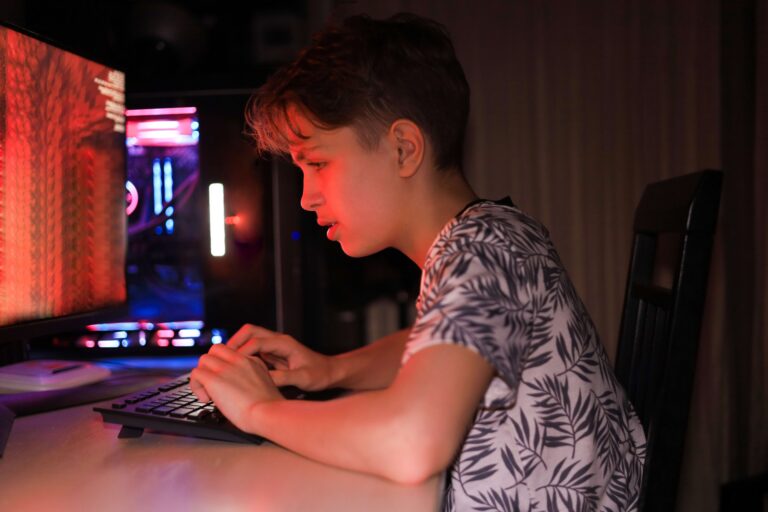
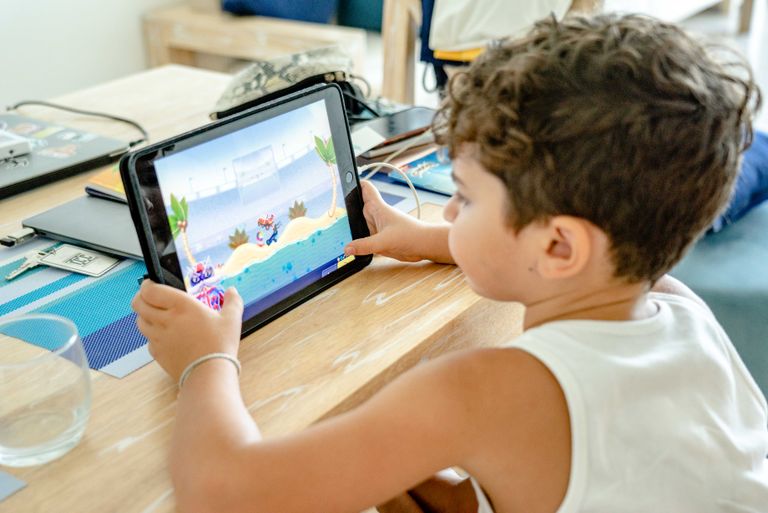
Screen time is different from the other technologies on this site because of what it does for these children in the moment. Many neurodivergent kids do not just like screens; they experience them as unusually calming and rewarding. Digital environments offer clear rules and goals, fast and frequent feedback, predictability, control over the pace, and very little friction. That is a good match for a child whose executive function skills are still developing, which is why you may find yourself saying that your child can focus on watching YouTube for hours but not on homework for 10 minutes.
Here is the catch, and it is the heart of this page. The same qualities that make a screen so easy to engage with are the qualities that let a child get by without using much executive function at all. The screen supplies the structure, holds the next step, and delivers the reward, so the child’s own planning, working memory, and self-direction get little exercise. And the hours spent on screens are hours not spent on the messier, less structured play that actually builds those skills. This is a developmental issue, not a moral one.
How screen time shows up at home, and what is actually happening.
|
What you see at home |
The executive Function involved |
Why Screen Time engages it |
|---|---|---|
|
Can focus on a game for hours but not on homework |
Sustained attention and task initiation are hard for effortful, low-reward work |
The screen supplies constant stimulation and reward, so little of the child’s own sustained attention is required |
|
Follows a game’s steps but forgets a three-step chore |
Working memory |
The game holds the steps and cues each next action, so working memory is offloaded rather than exercised |
|
Loses track of time on a screen more than anywhere else |
Time management and the internal sense of time passing |
Screens remove the natural cues that mark time, so time awareness tends to weaken, not grow |
|
Melts down when it is time to stop |
Flexibility and self-management |
The screen is predictable and low-friction, so it offers little practice tolerating frustration or shifting gears |
|
Chooses screens over unstructured, real-world play |
Flexibility and self-direction grow through friction |
Screens remove the friction, so the very experiences that build these skills get displaced |
Part 2
What Screen Time Can Help With
Let us be clear about the evidence. For most children, ordinary screen time is not a path to stronger executive function, and passive screen time does the least of all. The exceptions are specific and intentional, and they are worth knowing about.
1
Content Made to Teach the Skill
The clearest exception is content built on purpose to teach executive function. There are videos and programs designed to explain what a skill is and to walk a child through real projects that practice it, such as planning a task, organizing a space, or managing a stretch of time. Used deliberately, and paired with actually doing the project, this kind of content can help. Passive watching on its own will not.
2
Active and Creative Use Beats Passive Scrolling
Not all screen time is the same. Building, designing, problem-solving, and creating inside a game or app can call on planning, organization, and flexible thinking. Passive scrolling and autoplay video ask almost nothing of those skills. When screen time is going to happen, the active and creative end of the spectrum is the better place for it.
3
Whole Play: Letting Screen Interest Pull Toward the Real World
One of the most useful moves is what we call Whole Play, using the pull of a screen to lead a child into real-world activity. An interest in building games becomes actual building, design, and storytelling. A science video becomes a kitchen experiment. Here the screen is the on-ramp, and the executive function practice happens off the screen, where it counts most.
4
Screens as a Support, Not the Practice Itself
A device can also serve as an ongoing support: a timer, an alarm, or a checklist that reminds a child what comes next. That is a legitimate and lasting use, and the goal there is not to outgrow the tool but to get good at using it. We cover those supports in detail on the Executive Function and Technology page.
Part 3
What to Watch Out For
The concern with screen time and executive function is less about any single thing a screen does, and more about what heavy screen use quietly replaces.
Displacement Is the Real Cost
The biggest risk is everything a screen replaces. Flexibility, self-direction, and general self-management grow through unstructured, real-world play, the kind with boredom, negotiation, and the friction of working things out with other kids. Every hour on a screen is an hour not spent building those skills. For a child whose executive function is already fragile, that trade adds up quickly.
Passive Screen Time Does the Least
Passive watching and endless scrolling ask almost nothing of a child’s executive function, and can leave them more restless and less regulated afterward. If screen time is going to happen, steer it toward the active, creative, and social end and away from passive consumption.
Screens Weaken the Sense of Time
Screens strip out the ordinary cues that tell us time is passing. A child with the weakest internal clock ends up in the setting with the fewest external ones, so time awareness gets harder, not easier. Build time back in on purpose, with visible timers and clear, agreed stopping points.
Transitions Are Where It Breaks Down
The hardest moment is almost never the screen time itself; it is the stop. A predictable, low-friction, absorbing activity is exactly what a still-developing brain least wants to leave. Meltdowns at the end are less about defiance than about a regulation demand the child is not yet ready for. Warnings, predictable routines, and a calmer landing activity help more than lectures.
Protect Sleep and Movement
Screens before bed disrupt sleep in children who already struggle to settle, and physical movement has some of the strongest evidence we have for supporting attention and executive function. Screen time works least well when it eats into sleep and movement, and best when it sits alongside them.
Part 4
Sources for Research and Additional Information
Less-Structured Time in Children’s Daily Lives Predicts Self-Directed Executive Functioning
Barker, J. E., Semenov, A. D., Michaelson, L., Provan, L. S., Snyder, H. R., & Munakata, Y. — Frontiers in Psychology, 5, 593 (2014).
https://www.frontiersin.org/journals/psychology/articles/10.3389/fpsyg.2014.00593/full
Screen Time and Executive Function in Toddlerhood: A Longitudinal Study
McHarg, G., Ribner, A. D., Devine, R. T., & Hughes, C. — Frontiers in Psychology (2020).
https://www.ncbi.nlm.nih.gov/pmc/articles/PMC7643631
Relation Between Executive Functions and Screen Time Exposure in Under-6-Year-Olds: A Meta-Analysis
Computers in Human Behavior (2023).
https://www.sciencedirect.com/science/article/pii/S0747563223000900
Executive Functions
Diamond, A. — Annual Review of Psychology, 64, 135–168 (2013).
https://www.annualreviews.org/content/journals/10.1146/annurev-psych-113011-143750
Conclusions About Interventions, Programs, and Approaches for Improving Executive Functions That Appear Justified and Those That, Despite Much Hype, Do Not
Diamond, A., & Ling, D. S. — Developmental Cognitive Neuroscience, 18, 34–48 (2016).
Join our Newsletter!
More about Screen Time and Executive Functions




Finding the Right Technology for Your Child
No single app, game, or platform is right for every neurodivergent child. That’s why Digitally Nutritious maintains a searchable database of technology guides designed specifically for neurodivergent kids and teens.
Each guide explains why a tool may be helpful, which skills it supports, what to watch out for, and how to use it intentionally.
The goal isn’t to find “more” technology—but to find better-fit technology that supports your child’s development, strengths, and long-term growth.