
Obsessive, Perfectionistic, and Compulsive Behaviors and Technology
While the ways that technology can help children with obsessive, perfectionistic, and compulsive behaviors are limited, there are several applications worth highlighting. However, the line between this type of child’s ordinary technology habits and an emerging compulsive pattern can be hard to see from the outside.
Part 1
Why Technology Is Different for Kids with Obsessive, Perfectionistic, and Compulsive Behaviors
This page is part of our section on obsessive, perfectionistic, and compulsive behaviors, and it looks at how those patterns intersect with technology. If you want the fuller picture of what we mean by obsessions, perfectionism, and compulsions, and how we think about them, the foundations page for this section is the place to start. In brief: obsessions are thoughts a child gets stuck on and cannot easily set aside; compulsions are behaviors a child feels driven to repeat to relieve discomfort; and perfectionism is the need to have things just so, often with anxiety when they are not. They overlap, they sit on a spectrum, and most children who show them do not have a formal diagnosis.
Many of these children have shown the underlying temperament for years: a preference for sameness, narrow and intense interests, careful and precise habits, and sensitivity to anything feeling not quite right. Those traits are not problems in themselves, and many children who have them never develop a disorder. They matter here because technology can press on exactly these tendencies, and because the point at which an intense interest or a careful habit tips into something that costs a child time, distress, or flexibility is often hard to see from the outside.
Technology interacts with this picture in specific ways, and the research base is smaller than parents might expect. One large prospective study following more than nine thousand preteens over two years found that each additional daily hour of video game play was associated with roughly a thirteen percent increase in the odds of developing new obsessive-compulsive symptoms, and each additional hour of watching videos with roughly an eleven percent increase, while ordinary television did not show the same link. The mechanisms the researchers proposed are specific rather than general: interactive, content-rich, algorithm-driven platforms allow patterns of engagement, re-engagement, and narrowing focus that parallel the very loop these children are prone to. The problem is not screens in general; it is the way certain digital environments can reinforce the mechanisms these children already lean toward.
A note on research: The evidence base connecting technology use to these patterns in children is still emerging. The prospective study cited above is among the clearest pieces currently available, and the mechanisms it proposes align with what clinicians see in practice. Treat this page as a framework for thinking rather than settled science; we will update it as the research grows.
How these patterns shape technology use, and what you are seeing at home.
|
What you see at home |
What’s happening in the brain |
Why tech engages it |
|---|---|---|
|
Gets intensely stuck on a particular app, game, or content area, and screen routines have become inflexible. |
The pattern mirrors the structure of a compulsion. Engagement provides relief, disengagement produces distress, and the child returns as soon as they can. For a child prone to getting stuck, a favorite game or app becomes the hardest thing to leave. |
Variable rewards, immersive worlds, predictable mechanics, and open-ended play are engineered to be difficult to stop. For a child whose brain is already prone to relief-seeking through repetition, digital environments offer an unusually efficient version of that loop. |
|
Repeatedly asks how much longer they can play or whether they can play again, checks their score or progress over and over, and redoes parts of a game or task until they feel just right. |
Checking and redoing are among the most common compulsive and perfectionistic patterns. The underlying need is reassurance, that they are not missing out, that nothing has gone wrong, or that it is good enough, and the relief each check brings fades quickly, so the next one is never far away. |
Games and apps keep the score, the timer, the level, and the next reward always a tap away, so a child can check where they stand or start over again and again, and there is always a reason to ask for one more turn. |
|
Becomes absorbed in videos or content clustered around one narrow theme, watching the same kinds of clips or reading about the same topic for long stretches of time. |
Narrow focus and fixations are part of OCD’s presentation in children. The child’s attention settles onto a single content space and resists moving off of it. |
Recommendation algorithms quickly learn what holds the child’s attention and feed more of the same back. For a child whose mind is already drawn to narrow focus, the algorithm does the narrowing for her and makes it progressively harder to escape. |
Part 2
What Technology Can Help With
Technology is not a treatment for obsessive, perfectionistic, or compulsive behaviors, and the ways it can legitimately help are narrower than for some of the other diagnoses on this site. But there are several applications worth highlighting.
1
Externalizing Rigidity Onto a Trusted System
These children are often rigid by nature and prone to checking, and much of that energy gets spent on the cognitive work of tracking: whether homework is done, whether something was put away, whether a rule was followed, whether the work is good enough. Simple organization apps such as calendars, planners, homework trackers, and checklist tools can sometimes help a child offload that tracking onto a trusted external system, provided the child is willing to let the system do the work. When it works, the child can point to the app and say “it is written down,” and some of the internal rumination can settle. The crucial condition is that the child lets go of their own need to keep checking and hands it to the technology, rather than adding the app as one more layer of checking. This usually works best when introduced thoughtfully, often with a therapist, rather than handed to the child and hoped for.
2
Using Technology’s Variety to Expand Narrow Interests
By their nature, obsessive interests and compulsive routines are narrow and limiting. The child’s attention settles onto a small number of subjects, activities, or ways of doing things and resists moving off them. Technology, by contrast, is unusually broad. Within a single platform like Roblox, a child can move through dozens of different worlds and game types; within a game like Minecraft, a child can take on different quests, building styles, and modes of play. Parents who can gently encourage their child to try a new mode, a new world, or a different kind of activity within the platforms they already use are helping to build a small but important skill: flexibility. For a child whose mind keeps pulling toward the narrow, a platform that offers genuine breadth is an accessible place to practice the opposite move.
3
Physical Flexibility Through Exercise and Yoga Videos
Regular physical exercise has been shown to reduce obsessive-compulsive symptoms, and yoga specifically has shown encouraging results as an add-on. The useful angle here is that technology is the delivery mechanism. A child who resists a formal exercise program will often happily follow along with a kid-oriented yoga video, a cartoon-style stretching routine, or a short movement clip designed to be fun rather than clinical. Parents can use the medium’s engagement to build a physical routine that sticks. Ten minutes of stretching before bed, using a video the child enjoys, can become a healthy routine that replaces a less healthy one, and it may also support sleep, which anxiety and compulsions frequently disrupt.
4
Channeling Detail-Orientation and Perfectionism Into Work That Rewards It
A caveat first. These children are often genuinely uncomfortable with their compulsions, and we are not suggesting that obsessive-compulsive difficulty is a gift. But alongside the parts they would rather be free of, many of these children carry real strengths in precision, care, and attention to detail, the very heart of perfectionism. Technology offers an unusually good set of environments where those strengths are rewarded rather than punished. Careful proofreading, coding, digital design, video editing, and spreadsheet work all require exactly the kind of noticing—what is not quite right— that these children often do well. Helping a child find a domain where their drive to do things particularly well produces visible, respected results can be a real source of self-esteem, provided any underlying anxiety or OCD is also being addressed.
5
Present-Orientation and Mindfulness Apps.
By definition, a child who is in the grip of an obsession is not in the present moment. Her mind is somewhere else, running the worry or the ritual. Apps designed to support mindfulness, breath awareness, and simple present-orientation exercises can give a child a concrete tool for coming back to the room she is actually in. The research base here is mostly with adults, and the relief these tools offer is modest rather than dramatic, but for many children a brief mindfulness practice embedded in an engaging app can be a real help. This is technology used to counter the mechanism of OCD rather than to accommodate it.
Part 3
What to Watch Out For
For these children, the cautions on this page are particularly important. The mechanisms that make certain digital environments engaging for everyone can align uncomfortably well with obsessive, perfectionistic, and compulsive tendencies, and the line between a child’s ordinary screen habits and an emerging compulsive pattern can be hard to see from the outside.
Compulsive Engagement With a Particular App or Game
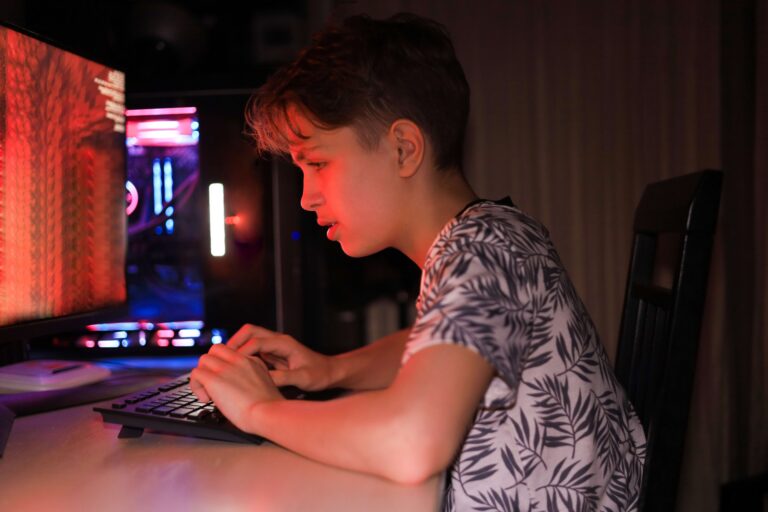
One of the most reliable patterns clinicians see is a child becoming stuck on a single app, game, or content area in a way that goes beyond ordinary preference. The child feels they cannot stop, experiences genuine distress when asked to, and returns at every opportunity. Interruption is an especially important feature. For a child driven by compulsion or perfectionism, stopping before something is complete causes distress in general, not only with screens, and the same mechanism shows up in gaming and app use. If a child needs to reach the end of a level, finish a quest, or collect the last item in order to feel settled, being pulled away before that point can trigger distress out of proportion to the activity. Parents often read this as ordinary upset about screen time, and sometimes it is, but for these children it can be something more specific: a compulsion, or a need to finish perfectly, that was not allowed to complete. The prospective research suggests the pattern is not just about content: interactive, endlessly re-engageable environments appear to reinforce the loop of distress and relief these children are built around, and can accelerate it rather than merely reflect it.
Algorithmic Compulsion Engines
Recommendation systems on video and social platforms are designed to learn what holds a user’s attention and serve more of the same. For a child prone to obsessive fixation, this creates something that can reasonably be called an algorithmic compulsion engine. The child enters with a mild interest. The algorithm notices and serves more. The interest narrows. The algorithm notices the narrowing and serves more still. Over weeks, what began as a curiosity is shaped into something closer to a fixation, and the environment is actively pulling the child toward the very pattern the family is trying to interrupt. Parents often notice late, because from the outside the child is just watching videos, and each individual clip looks unremarkable. The problem is the trajectory, not the content.
Devices as an Infinite Opportunity for Checking
Checking is among the most common compulsive patterns in children, and perfectionism adds its own version, redoing until it feels right. Digital devices offer more opportunities for both than any prior environment. The child can check messages, check that homework saved, check that the right file uploaded, reread and rewrite a post, redo a level, check, check, check. Because each individual check or redo is low-effort, the behavior can escalate without a parent noticing, and the reassurance each one provides fades quickly enough that the next is never far away.
Screen Routines Becoming Ritualized
For a child who is already comforted by sameness, the predictability of screen time can become ritualized in a way that is harder to interrupt than an ordinary habit: the same game, in the same order, at the same time, with the same outcome, day after day. The rigidity often shows up most when the routine is disrupted. A child who expects an hour of a game after school, and instead has to leave for an appointment, go to a sibling’s event, or do something else that breaks the pattern, may react with distress far bigger than the change seems to warrant, not simply disappointed but genuinely thrown by the loss of the expected sequence. When a parent changes the timing, the order, or the amount and is met with real upset rather than ordinary grumbling, it is often an early sign that screen time has crossed from a favored activity into a compulsive one.
Telling Ordinary Screen Attachment From an Emerging Compulsion
All of these patterns exist on a spectrum, and most children show some of them some of the time. The signals that something is clinically concerning rather than developmentally ordinary are specific: the behavior causes real distress when interrupted, it takes up significantly more time than similar behavior in peers, it is starting to interfere with school, friendships, or family life, and the child experiences it as something they cannot control. When those signals are present, a consultation with a clinician who understands OCD, anxiety, and compulsive patterns in children is the right next step.
Part 4
Sources for Research and Additional Information
Screen Time and Obsessive-Compulsive Disorder Among Children 9–10 Years Old: A Prospective Cohort Study
Nagata, J.M., et al. (2022). Journal of Adolescent Health.
https://pmc.ncbi.nlm.nih.gov/articles/PMC9975071
Effects of Exercise on Obsessive-Compulsive Disorder Symptoms: A Systematic Review and Meta-Analysis
Bottoms, L., Prat Pons, M., Fineberg, N.A., et al. (2023). International Journal of Psychiatry in Clinical Practice.
https://www.tandfonline.com/doi/full/10.1080/13651501.2022.2151474
Effectiveness of Add-on Yoga in Reducing the Symptoms of Obsessive Compulsive Disorder (OCD): A Randomized Controlled Trial
Bhat, S.G.S., et al. (2024). Asian Journal of Psychiatry.
https://pubmed.ncbi.nlm.nih.gov/39079446
International OCD Foundation
International OCD Foundation (IOCDF).
The Parent’s Role in OCD Treatment
Child Mind Institute.
https://childmind.org/article/kids-and-ocd-the-parents-role-in-treatment
Cosmic Kids Yoga
Cosmic Kids Yoga (YouTube channel).
Join our Newsletter!
More about Obsessive, Perfectionistic, and Compulsive Behaviors and Technology




Finding the Right Technology for Your Child
No single app, game, or platform is right for every neurodivergent child. That’s why Digitally Nutritious maintains a searchable database of technology guides designed specifically for neurodivergent kids and teens.
Each guide explains why a tool may be helpful, which skills it supports, what to watch out for, and how to use it intentionally.
The goal isn’t to find “more” technology—but to find better-fit technology that supports your child’s development, strengths, and long-term growth.