
Neurotechnologies and Executive Functions
A growing number of devices promise to strengthen focus, attention, and other executive function skills. Some of that promise is real and worth knowing about, and some of it runs ahead of the evidence.
Many children who have executive function challenges also display some of the signs and symptoms, or perhaps even a diagnosis of:
- ADHD
- Autism Spectrum Disorder
- Learning Disabilities
- Mood or Anxiety Disorders
- Behavioral Disorders
Children display symptoms such as inattention, sadness, sensory difficulties, and struggles to process or learn new information, but do not warrant a formal psychiatric diagnosis. However, it is quite common to see these children struggle with executive functioning skills, which may interfere with their performance at school, getting things done at home, or managing their own behaviors and emotions.
We treat each executive function as a skill that can be taught and practiced. To see how we define and organize them, read A Skills-Based Model of Executive Functions. Some of these skills are mostly cold, meaning they help a child manage information, time, and tasks. Others are hot, meaning they help manage impulses and emotions. This page focuses on the cold, learning-management skills, while the hot skills are addressed in our behavioral and mood materials.
Neurotechnologies are a broad and fast-moving category. On this page, the term covers tools designed to support and improve the mental health, learning, and development of neurodivergent kids. These are not tools your child stumbles across on the App Store. They are intentional interventions that range from rigorously FDA-reviewed treatments to well-designed wellness apps, often backed by clinical research.
They come in the form of video games, VR tools, game-based digital therapeutics, wearable monitors that prompt and track attention, and computerized cognitive training. Many of these neurotechnologies are in their infancy, with the first regulatory landmarks having been reached, which also means families may be more likely to encounter marketing that runs ahead of the evidence.
Several of these tools target specific executive function skills, especially focus and attention, working memory, and, increasingly, time management and organization. Some of the best data comes from EndeavorRx, a game-based digital therapeutic designed to improve sustained attention and focus, which in 2020 became the first prescription video game cleared by the FDA. Wearable platforms such as Revibe aim to enhance focus and attention by bolstering self-regulation, using gentle vibration and text reminders. A distinctive feature of many neurotechnologies is that they provide feedback to both the child and the parents or teachers who are watching how the tools are used.
|
What you see at home |
The executive function involved |
How neurotechnology engages it |
|---|---|---|
|
Struggles to sustain attention on anything that is not immediately engaging |
Sustained attention is impaired at a neurological level |
Game-based digital therapeutics and neurofeedback target the brain’s attention networks directly |
|
Forgets steps and loses track while doing multi-part tasks |
Working memory is limited |
Computerized working memory training exercises those circuits, with gains on the trained tasks |
|
Stays disorganized and off task despite reminders |
Organization and self-monitoring take sustained effort |
Devices track on-task behavior and feed that information back to the child and to caregivers |
|
Responds to games and challenges but tunes out conventional formats |
The executive function brain needs stimulation and clear feedback |
Neurotechnologies are built around that engagement, which can make the intervention itself more accessible |
Part 2
What Neurotechnologies Can Help With
This is the area of the site where the evidence is furthest along, and also the area where the gap between a promising study and a finished product is easiest to miss. The tools below are the ones worth discussing with a clinician.
One distinction runs through all of this. Some neurotechnologies aim to train a skill so that it strengthens over time. Others, including wearables, mental health wellness tools, and reminder apps, provide ongoing support that prompts and reminds the child in the moment. With those, the goal need not be to eventually do without the tool. Practice builds the habit and expertise in using a device well and reliably, and staying on task can be a good outcome in itself.
1
Focus and Sustained Attention
Game-based digital therapeutics are the most developed tools in this space. EndeavorRx, cleared by the FDA in 2020 as the first prescription video game, was studied in more than 600 children, and about two-thirds of parents reported improvement in ADHD-related impairments after two months of use. It is a prescription product used under clinical oversight, not an app to download on your own, and it is designed to exercise the attention systems that executive function depends on.
2
Neurofeedback and Biofeedback for Self-Regulation
Neurofeedback for attention has been studied for more than three decades, and large reviews have shown modest effects on attention and hyperactivity. The picture is genuinely contested: a large, rigorous trial found no significant benefit on blinded outcome measures. Biofeedback tools that train heart rate variability and physiological arousal provide a child with a visible signal of their internal state. Most clinicians treat these as an option for families who cannot access or tolerate other treatments, or as an addition to other treatments, rather than as a stand-alone fix.
3
Wearables That Prompt Focus and Support Self-Regulation
Wearable platforms such as Revibe deliver gentle vibration and text reminders that nudge a child back on task and build self-monitoring, while tracking on-task behavior and sending feedback to parents and teachers. An open-label pilot reported parent- and teacher-rated improvements in attention, organization, and self-monitoring after four weeks. These tools are not FDA-cleared medical treatments, and the early evidence, while encouraging, is not yet from blinded, controlled trials.
4
Working Memory Training
Computerized working memory training uses game-like formats to exercise the working memory circuits that executive function relies on. Gains on the trained tasks are fairly well established. Whether those gains carry over to homework, routines, and daily life is far less certain, so it is best to expect better performance on the training itself, not an automatic change in how the day goes.
5
Emerging Tools for Time Management, Organization, and Social Awareness
A newer wave of devices and apps aims at time management, organization, and, in some cases, social awareness, often through prompts, cues, and feedback loops. The rationale is sound, and the direction is promising, but the evidence here is still thin. Treat these as early-stage tools worth watching rather than settled solutions.
Part 3
What to Watch Out For
Neurotechnologies are truly in their infancy. While clearly promising because they are directed specifically at the skills that neurodivergent children need, there remain a number of questions as to how generalizable the improvements made are for the real world.
The Evidence Base Is Contested, Not Settled
Even here, where the research is most developed, key findings are disputed. The most rigorous recent trial of neurofeedback found no significant benefit on blinded measures, and working memory training shows gains on trained tasks but inconsistent carryover to real life. When you see a tool marketed as an established treatment, the useful question is not only whether it has been studied, but what the most rigorous studies actually found.
Some of These Require Clinical Oversight
FDA-cleared digital therapeutics are prescription-grade interventions, not apps to use on your own. A clinician is the right entry point, the person who can interpret results, adjust how the tool is used, and fit it alongside other supports. Using one as a stand-alone solution carries the same risks as using medication without medical guidance.
Gains on the Task Do Not Automatically Transfer to Daily Life
This is the most consistent caution in the whole category. A child who improves on a training task or inside a device may not automatically manage homework, a backpack, or a morning routine any better. Carrying a gain from the tool into real life takes a deliberate, guided effort, usually with an adult helping the child connect the two.
Monitoring Raises Privacy, Stigma, and Identity Concerns
Devices that track attention collect data that may be stored or shared in ways that are not always clear to families. A visible device can carry social stigma, and constant monitoring can leave a child feeling that something about them is broken rather than simply wired differently. Child assent, a genuine understanding of how data is used, and attention to the child’s self-concept all belong in the decision.
Cost and Access
Neurotechnology tools, including neurofeedback, working memory systems, and wearables, are often expensive and rarely covered by insurance. Families who invest heavily based on promising but preliminary evidence can be disappointed if the benefits do not materialize at the scale marketed. Realistic expectations, a good fit between the neurotechnology and the child’s needs, and honest guidance about where a specific tool sits in the evidence matter a great deal here.
Part 4
Sources for Research and Additional Information
A Novel Digital Intervention for Actively Reducing Severity of Paediatric ADHD (STARS-ADHD): A Randomised Controlled Trial
Kollins, S. H., et al. — The Lancet Digital Health, 2(4), e168–e178 (2020).
https://doi.org/10.1016/S2589-7500(20)30017-0
An Open-Label Study of a Wearable Device Targeting ADHD, Executive Function, and Academic Performance
Brancaccio, R., Weiss, M. D., et al. — open-label pilot study (2023).
https://www.ncbi.nlm.nih.gov/pmc/articles/PMC10741604
Neurofeedback Training for Executive Function in ADHD Children: A Systematic Review and Meta-Analysis
Zhong, X., Yuan, X., Dai, Y., Zhang, X., & Jiang, C. — Scientific Reports, 15, 28148 (2025).
https://www.nature.com/articles/s41598-025-94242-4
Working Memory Training Does Not Improve Performance on Measures of Intelligence or Other Measures of “Far Transfer”
Melby-Lervåg, M., Redick, T. S., & Hulme, C. — Perspectives on Psychological Science, 11(4), 512–534 (2016).
https://journals.sagepub.com/doi/10.1177/1745691616635612
Conclusions About Interventions, Programs, and Approaches for Improving Executive Functions That Appear Justified and Those That, Despite Much Hype, Do Not
Diamond, A., & Ling, D. S. — Developmental Cognitive Neuroscience, 18, 34–48 (2016).
https://doi.org/10.1016/j.dcn.2015.11.005
Effectiveness of Technology-Based Interventions for School-Age Children with ADHD: Systematic Review and Meta-Analysis of RCTs
JMIR / PMC (2023).
Join our Newsletter!
More about Neurotechnologies and Executive Functions


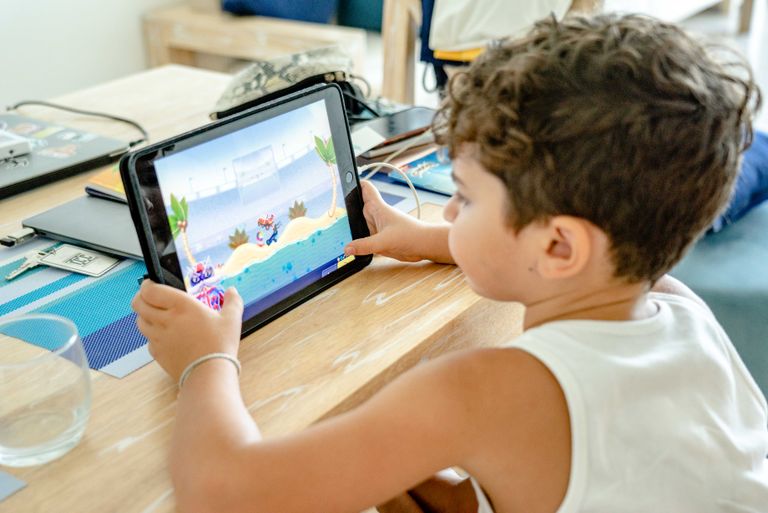



Finding the Right Technology for Your Child
No single app, game, or platform is right for every neurodivergent child. That’s why Digitally Nutritious maintains a searchable database of technology guides designed specifically for neurodivergent kids and teens.
Each guide explains why a tool may be helpful, which skills it supports, what to watch out for, and how to use it intentionally.
The goal isn’t to find “more” technology—but to find better-fit technology that supports your child’s development, strengths, and long-term growth.