
Neurotechnologies and Processing Disorders
Neurotechnology tools for children with learning disabilities are most useful when they target the specific neurological bottleneck the child is dealing with.
Processing disorders is a broad category. The most familiar examples are auditory processing disorder, where a child has trouble interpreting speech in noisy classrooms or following multi-step verbal directions even with normal hearing; visual processing disorder, where a child struggles to interpret visual information even with normal vision; and language processing disorder, where the bottleneck sits between hearing words and understanding them. Maya’s profile, slow processing speed, sits across all of these. It is the speed at which the brain takes in information and produces a response. A child with slow processing speed may know everything the teacher just asked and still need extra time to get her hand up. By the time she gets there, the conversation has moved on.
These difficulties are common, often comorbid with other diagnoses, and frequently underestimated. Children like Maya can look like they are not trying hard enough, or like they have an attention problem, when in fact what they have is an output problem. They know the answer; they cannot get it out fast enough. The frustration that builds in these children is its own clinical concern. Bright children who consistently fall behind their peers on timed tasks begin to develop a story about themselves that does not match reality, and self-esteem effects accumulate.
The neurotechnology conversation in this column looks different from the others on this site. For most diagnoses, the question is whether technology can address a specific symptom or function. For processing disorders, the question is whether the speed of the brain itself can be trained, and the data is mixed. The most encouraging research on cognitive training and processing speed has been done in older adults, where studies from groups including Michael Merzenich’s team at Posit Science have shown that targeted training can produce measurable gains in speed of processing, with transfer to real-world tasks like driving. The pediatric research has not yet caught up. Whether the same training principles will work as well in a developing brain, on a different cognitive bottleneck, in a child whose attention and motivation systems are still maturing, is an open question. There is reason to be optimistic given how readily children engage with technology, and reason to be cautious because the evidence is not yet there.
A separate line of research, often associated with high-performance sports, has examined whether visual-motor speed and fast decision-making can be improved through specialized training. Three-dimensional multiple-object tracking systems, where a viewer follows several moving targets among distractors on a screen, are now used by professional teams in football, hockey, and soccer to train the kind of perceptual speed that elite quarterbacks rely on; I wrote about this in an April 2026 Psychology Today piece on the NFL draft. The pediatric clinical evidence is thinner than the elite-athlete evidence. The underlying mechanism, training the brain to process visual information more quickly under load, is potentially relevant for children whose bottleneck is on the input side rather than the output side, but families should expect the research base in children to take time to mature.
A note on the evidence:
|
What you see at home |
What’s happening in the brain |
Why neurotechnologies engage it |
|---|---|---|
|
Homework that should take twenty minutes takes ninety |
The brain is doing the work, just slowly. Each step requires more processing time than her peers need. |
Cognitive training programs that target processing speed have shown meaningful gains in older adults; pediatric application is plausible but still being studied. |
|
Tells you what she learned, but slowly, with pauses to find words |
Slow lexical retrieval and verbal output, even when comprehension is intact |
Working memory training and cognitive training programs target the underlying retrieval and processing systems, with mixed evidence on transfer to school performance. |
|
Frustrated by handwriting; her hand cannot keep up with what she is thinking |
Output bottleneck where the motor and visual-motor systems lag behind cognition |
Assistive technology that bypasses handwriting, including dictation and typing, lets her actual processing speed do the work without the motor delay. |
|
Knows the answer in class but rarely raises her hand fast enough |
Speed of access and output, not knowledge, is the limiting factor |
Visual-motor training tools and game-based cognitive training are designed to build fast-access performance, with stronger evidence in adults and athletes than in clinical pediatric populations. |
Part 2
What Neurotechnologies Can Help With
Neurotechnology tools relevant to children with processing disorders fall into a few groups, with very different evidence bases. The strongest evidence in the broader literature comes from older-adult populations and from elite-athlete training contexts. The pediatric clinical evidence is still being built. The three approaches below cover what families are most likely to encounter.
1
Auditory and language-processing training programs
These are computer-based programs that target the brain’s ability to perceive and discriminate rapid auditory information, with the rationale that improving the bottom-up processing of sounds will translate to improvements in language and reading. The most extensively studied program in this category has more than 250 research studies behind it. The evidence base is mixed: a landmark RCT and a subsequent meta-analysis have called the underlying temporal-processing hypothesis into question, while other research supports the use of these programs as an adjunct to conventional language intervention rather than as a stand-alone treatment. For a child with auditory processing disorder specifically, these programs may be worth a conversation with a speech-language pathologist or audiologist.
2
Cognitive training targeting processing speed and attention
This is the area Maya’s profile most directly points toward, and it is also where the pediatric evidence is thinnest. The strongest research on cognitive training and processing speed has been done in older adults, where targeted training produces measurable gains and, in some studies, transfers to real-world performance. Pediatric versions of this approach exist, including FDA-cleared game-based digital therapeutics for ADHD and computerized working memory training, and meta-analytic evidence in pediatric ADHD shows meaningful effects for executive function and attention. Whether those gains translate specifically to improved processing speed in school tasks, and whether they hold over time, is a separate question. A parallel research line in visual-motor and decision-making speed, used widely in elite sports, has produced impressive results in athletes; the pediatric clinical evidence base is still being built.
3
Assistive technology that bypasses the bottleneck
While the cognitive-training research catches up, the most reliable help for a child like Maya often comes from tools that simply remove the slowest step. Dictation and speech-to-text let her get her ideas onto the page at the speed she thinks them, rather than at the speed her hand can move. Typing instead of handwriting unlocks output for many children whose primary bottleneck is the motor execution of writing. Audio versions of texts let her absorb content without the additional drag of slow reading. None of these are neurotechnology in the strict sense, but they are the bridge most children with processing difficulties actually need while the more ambitious tools are being studied.
Part 3
What to Watch Out For
Even well-designed tools can be used in ways that limit the help they offer. The cautions below are about how these tools fit into the larger picture of supporting a child with processing difficulties, what to expect realistically, and what to watch for as your child develops.
The pediatric evidence is thin and the field is still being built.
Most of the research on cognitive training for processing speed has been done in older adults, who are losing speed, rather than in children whose brains are still developing. Whether the same training principles work in a developing brain, on a different cognitive substrate, is an open question. Companies in this space are beginning to run pediatric studies, which is encouraging. Parents looking at marketing claims about improving a child’s processing speed should ask what studies the claim rests on and in what population they were conducted.
Far transfer is the question that matters
A cognitive training program may produce real gains on the trained task, faster scores in the game, better numbers on the program’s own internal measures, without those gains transferring to school performance, homework completion, or daily life. This is the far-transfer question. Some studies show transfer; others do not. The thing parents care about, whether the child does better in class, is the harder thing to demonstrate.
Fast-paced training is not the same as the kind a slow-processing child needs
Many brain-training games run at high speed by design. For a child whose problem is processing speed, a fast-paced game can be alienating rather than helpful. The training that actually engages this child’s brain is often slower, more deliberate, and more carefully scaffolded than the consumer brain-training market reflects. Selecting tools that match the child’s actual capacity, rather than overwhelming her in the name of training, is part of the work.
Engagement before behavior change, given time
Like the other neurotech columns on this site, these tools tend to work in a sequence: engagement first, awareness second, performance change last. If your child is willing to use a cognitive training program, give it a real trial of several months before judging. The flip side is that engagement alone is not improvement; look for concrete markers (faster homework completion, less frustration, better class participation) over weeks and months.
Watch your child’s self-esteem at the third- or fourth-grade pivot
This is the age when children with slow processing speed start to notice the gap between their pace and their peers’. The conclusion they often draw on their own is that they are intellectually slower than the children around them, and that conclusion is almost always wrong. Speed of processing is one component of cognition. It is not the same thing as intelligence or reasoning. Many of these children think on their feet quite well when the task does not require visual search or written output, and that capability often shows up clearly in neuropsychological evaluations. The story you want them to internalize is that they take a bit longer to do certain things, not others, and that what matters most is getting to the right answer and being able to show their reasoning, not the speed at which it appears on the page. That story has to be supplied by the adults around them, because the playground will supply a different one.
Watch for changes in motivation, and frame neurotechnology realistically
Watch for the child who has always been a willing student and a hard worker and who seems to be losing that. A drop in motivation in a child who used to want to please her teachers and finish her work is often the most visible signal that processing speed is becoming a real obstacle in her day. If she is not already getting accommodations at school, this is the moment to talk to the teachers. Neurotechnology tools can sometimes help here, both by giving the child a sense that she is working on something concrete and by producing the kind of small, measurable gains that re-engage a discouraged child. Frame this carefully. The goal is some improvement in efficiency, not transformation. You are not going to take one of the slowest runners in the class and turn her into a sprinter who laps everyone, and the same is true here. If the tool helps her finish her homework a little faster, or speak up in class a little more readily, that is a real win. Setting any larger expectation tends to backfire.
One tool in a larger toolbox
Children with processing difficulties benefit most from an approach that combines several things at once: classroom accommodations including extended time and permission to dictate or type, assistive technology, work with a speech-language pathologist or other specialist when indicated, attention to comorbid conditions like ADHD, and family awareness of how exhausting fast-paced demands are for these children. A neurotechnology tool can take a real place in that toolbox. It is not the toolbox.
Part 4
Sources for Research and Additional Information
Processing Speed: The NFL Draft’s Hardest-to-Measure Skill
Kulman, R. Psychology Today (April 24, 2026).
Speed of Processing Training Results in Lower Risk of Dementia
Edwards, J.D., Xu, H., Clark, D.O., Guey, L.T., Ross, L.A., & Unverzagt, F.W. (2017). Alzheimer’s & Dementia: Translational Research & Clinical Interventions, 3(4), 603–611.
https://alz-journals.onlinelibrary.wiley.com/doi/10.1016/j.trci.2017.09.002
Meta-Analysis of the Efficacy of Digital Therapies in Children with Attention-Deficit Hyperactivity Disorder
He, F., Qi, Y., Zhou, Y., Cao, A., Yue, X., Fang, S., & Zheng, Y. (2023). Frontiers in Psychiatry, 16.
https://www.frontiersin.org/journals/psychiatry/articles/10.3389/fpsyt.2023.1054831/full
A Critical Systematic Review of the NeuroTracker Perceptual-Cognitive Training Tool
Vater, C., Gray, R., & Holcombe, A.O. (2021). Psychonomic Bulletin & Review, 28, 1458–1483.
https://link.springer.com/article/10.3758/s13423-021-01892-2
Bright Kids Who Can’t Keep Up: Help Your Child Overcome Slow Processing Speed and Succeed in a Fast-Paced World
Braaten, E., & Willoughby, B. (2014). Guilford Press.
https://www.guilford.com/books/Bright-Kids-Who-Cant-Keep-Up/Braaten-Willoughby/9781462516049
Understood.org: Slow Processing Speed
Understood.org.
https://www.understood.org/en/articles/processing-speed-what-you-need-to-know
Join our Newsletter!
More about Neurotechnologies and Processing Disorders


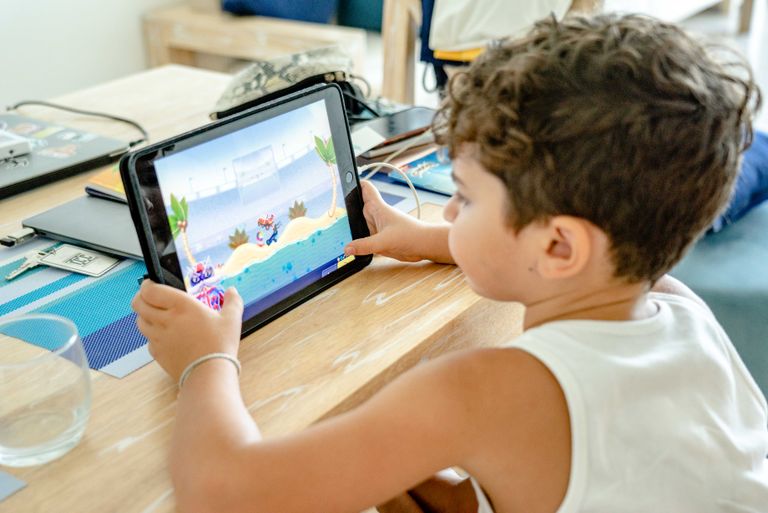



Finding the Right Technology for Your Child
No single app, game, or platform is right for every neurodivergent child. That’s why Digitally Nutritious maintains a searchable database of technology guides designed specifically for neurodivergent kids and teens.
Each guide explains why a tool may be helpful, which skills it supports, what to watch out for, and how to use it intentionally.
The goal isn’t to find “more” technology—but to find better-fit technology that supports your child’s development, strengths, and long-term growth.