
What Age Should Your Neurodivergent Child Get Their First Cell Phone?
Should we set different limits on access to technology for neurodivergent kids?
It’s very difficult for parents to know when to allow their children access to technology in the age of AI. And if you have a neurodivergent child, it’s even more confusing. We’d like to tell you that we have all the answers here at Digitally Nutritious, but we also recognize that, by their nature, neurodivergent children are diverse and develop at different rates. So there’s no one-size-fits-all solution. But it’s still a worthwhile exercise to ask these technology questions and see how they apply to your child.
Let’s start with smartphones (not minimalist phones, which we will address later). At what age should you let your neurodivergent child have their first phone? In the United States, 90% of kids have a smartphone by the age of 13. Even more remarkable, 42% of them have one by the age of 10. If you don’t like the idea of your ten-year-old carrying a smartphone that can reach anything on the internet, you’re not alone. And if I’m not mistaken, if your ten-year-old doesn’t have one yet, they’ve asked you for it more than once.
For most kids, once they get their cell phone, it becomes the launching pad for accessing everything else on the internet. That little magical computer in your child’s hand holds more computing power than the astronauts had when they went to the moon in 1969 (and with AI chatbots, it has only grown more powerful and scary since). Many parents are now pushing for dumb phones or flip phones until their kids are older. A decade ago, only about 20% of ten-year-olds had a smartphone, so even if you delay your child’s access to a phone, it has become far more likely that your child’s friends already have a cell phone than they did in the past.
Kids are growing up in a digital world, and no matter what we do, there is “virtually” nothing we can do to keep them from interacting with technology. My two grandsons, not even eighteen months old, are growing up in homes where their parents have essentially banned all types of television shows and movies. However, when they come to visit me, they are immediately drawn to the TV remote controls and have become adept at turning on the televisions within a moment or two. I have to gently remove the remotes from them so we don’t lose them and I don’t get in trouble with their parents. Screens beckon to children, even the very young ones, and most kids are remarkably good at finding their way to them.
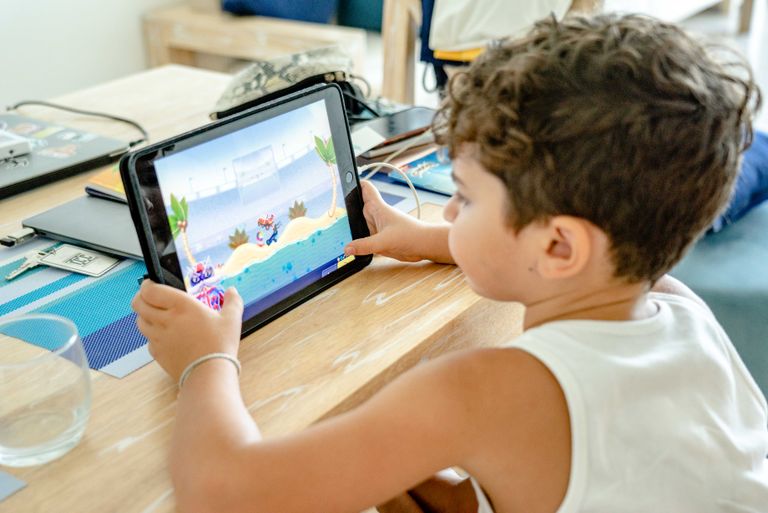
This push to give kids access earlier and earlier worries me, especially for the neurodivergent kids I work with in my clinical practice. Far too often, school-aged children visit me in my office, which is stocked with thousands of toys. Often, they quickly become bored with my indoor playground and start begging their parents for their phones. There are many reasons to consider delaying access to technology we give to younger children. Perhaps the most important one is that they may lose their interest in other forms of play.
What I have come to realize is that simply hunting for a number or age for tech access to hand parents is probably the wrong question. An age range is useful, and I will give you some recommendations at the end of this post. But what matters more is the sheer diversity of children and each child’s readiness to use the technology well, or at least to learn from the times they don’t.
My initial instinct to tell parents that their neurodivergent kids should just wait longer for everything is understandable, but it is also too simple, and sometimes it is flat wrong. Some kids on the autism spectrum, for example, communicate better through the slower, asynchronous back-and-forth of online platforms than they do face-to-face, and for them waiting longer would hold back their ability to connect. And for a child with ADHD who gets hyper-focused on Minecraft or Roblox, that game may be one of the few places they connect with classmates after school, which can make them more accepted during the school day.
Some parents think they can eliminate tech tools from their children’s play diet. I wish them good luck. Unfortunately, that is very hard to pull off, and it denies the child the chance to build the skills they need online. Neurodivergent kids need a good deal more supervision. We should expect they will not automatically know how to behave online and will need direct teaching. Ultimately, they will live in a world where technology matters, and helping them learn to navigate it has become a new part of good parenting.
Our team at Digitally Nutritious has developed a set of guidelines about appropriate ages for different technologies. We are in the process of creating a comprehensive chart of devices, apps, and online tools. The most important consideration when applying our recommendations is to look at your individual neurodivergent child and recognize their needs and developmental level.
Here are our recommendations for when your neurodivergent child should get a cell phone and use of other popular technologies.
Cell phones
Minimalist phone: 10 to 12. Smartphone: 12 to 15.
First off, smartphones are a very different animal from the minimalist or “dumb” phones now on the market. A minimalist phone, somewhere between 10 and 12, lets a neurodivergent child stay in touch with others without the dangers of the open internet. A full smartphone fits better between 12 and 15, depending on the child’s Developmental Fit.
Fortnite
13 and up.
Fortnite is rated T for Teen, and 13 and up is what we recommend as a core approach. Often it is the banter around the game, more than the game itself, that becomes the problem for neurodivergent kids. But if you have a 12-year-old and all of their friends are playing, you might give them a chance to play with your supervision. Before that, a good substitute is Lego Fortnite, which is rated E10+ (for everyone 10 and older).
Roblox
7 or 8 and up, with vigilant supervision.
Roblox is not a single game. It hosts millions of user-generated worlds, some perfectly fine for children, some highly inappropriate. More than any other game here, it calls for real parental awareness and supervision. With that in place, it can work from as early as seven or eight, all the way up through the teen years.
Social media: Instagram, TikTok, Snapchat
15 and up.
These platforms legally require users to be at least 13. Given how sensitive neurodivergent kids can be to them, we subscribe to 15 and up, increasingly the norm in countries outside the United States.
YouTube and YouTube Shorts
8 and up, but only with the controls in place.
Kids cannot watch Shorts within YouTube Kids, so they need a supervised setup that parents create through Google Family Link. When you use the controls that limit the kinds of Shorts, set age ranges, manage time, and turn off the endless scrolling feed, Shorts can be appropriate from about age 8. Without those controls, though, Shorts tend to be a real problem for focus and attention in many neurodivergent children.