Revibe
https://www.pearsonassessments.com/campaign/revibe.html
Overview
Revibe is a wristwatch that buzzes a child back to the task at hand. Every few minutes it vibrates, and the child is supposed to ask, “Am I doing what I’m supposed to be doing right now?” and answer with a tap on the watch. The idea comes from self-monitoring, a classroom strategy for kids with ADHD with more than 50 years of research behind it. Revibe moves the job of reminding from the teacher’s voice to the child’s wrist.
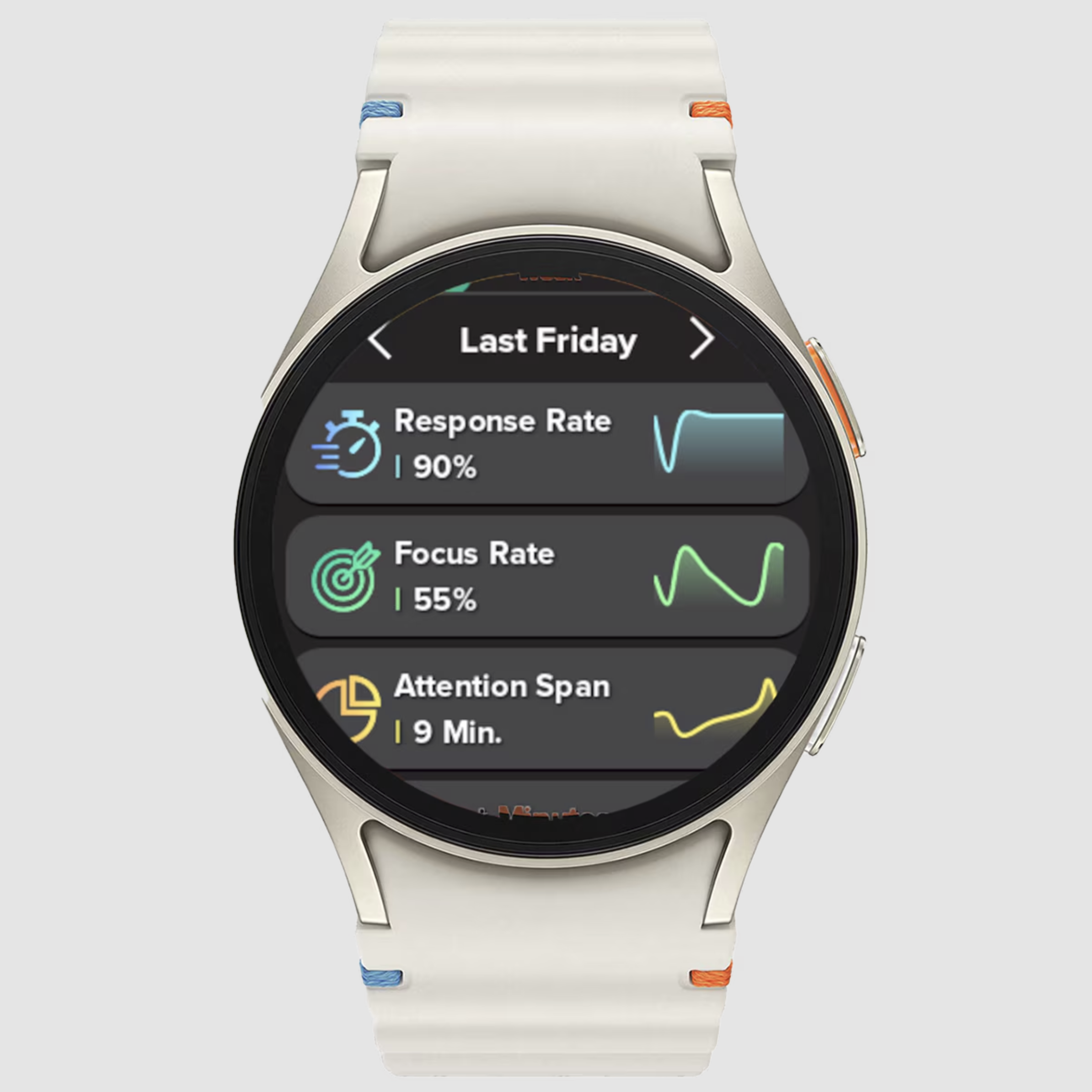
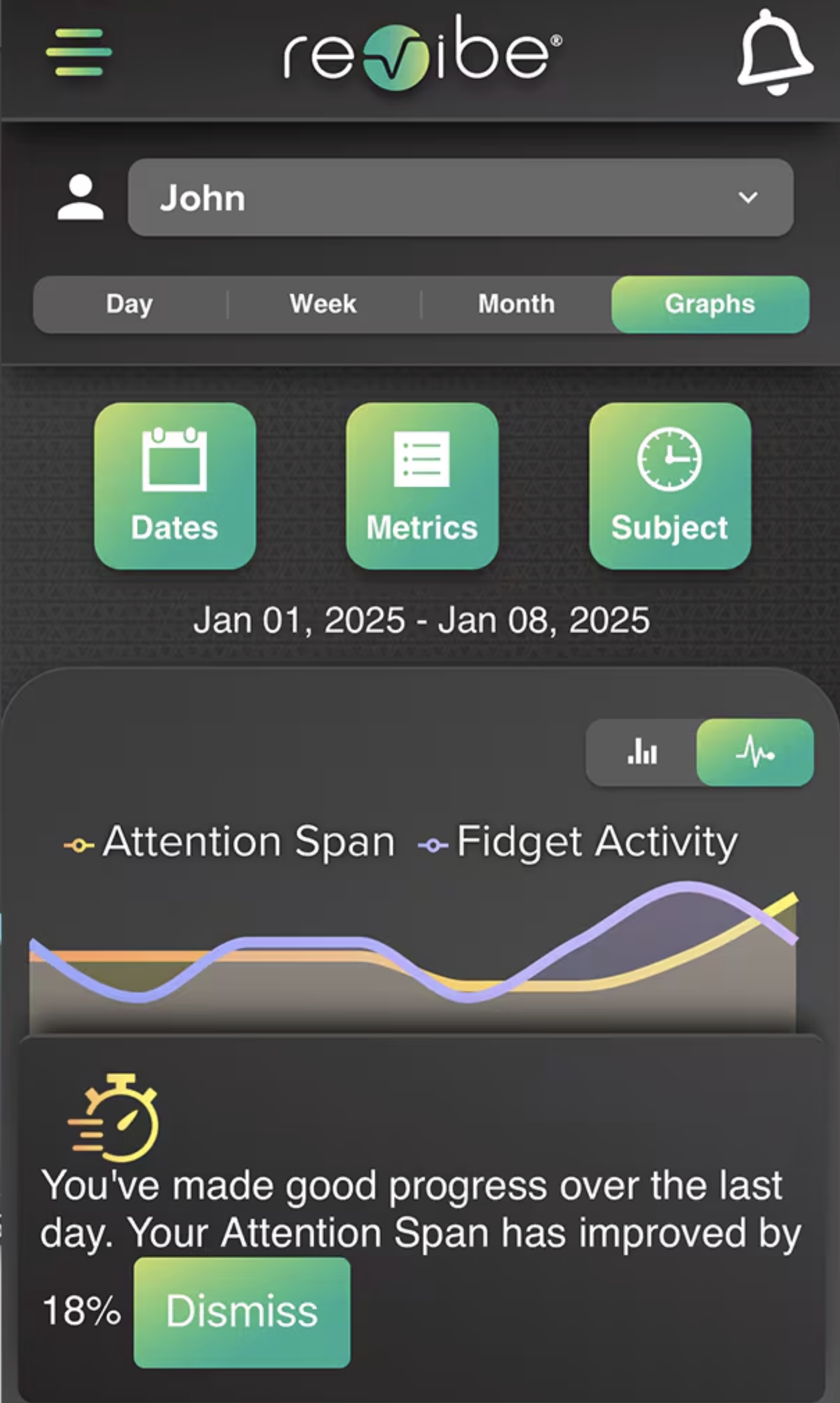
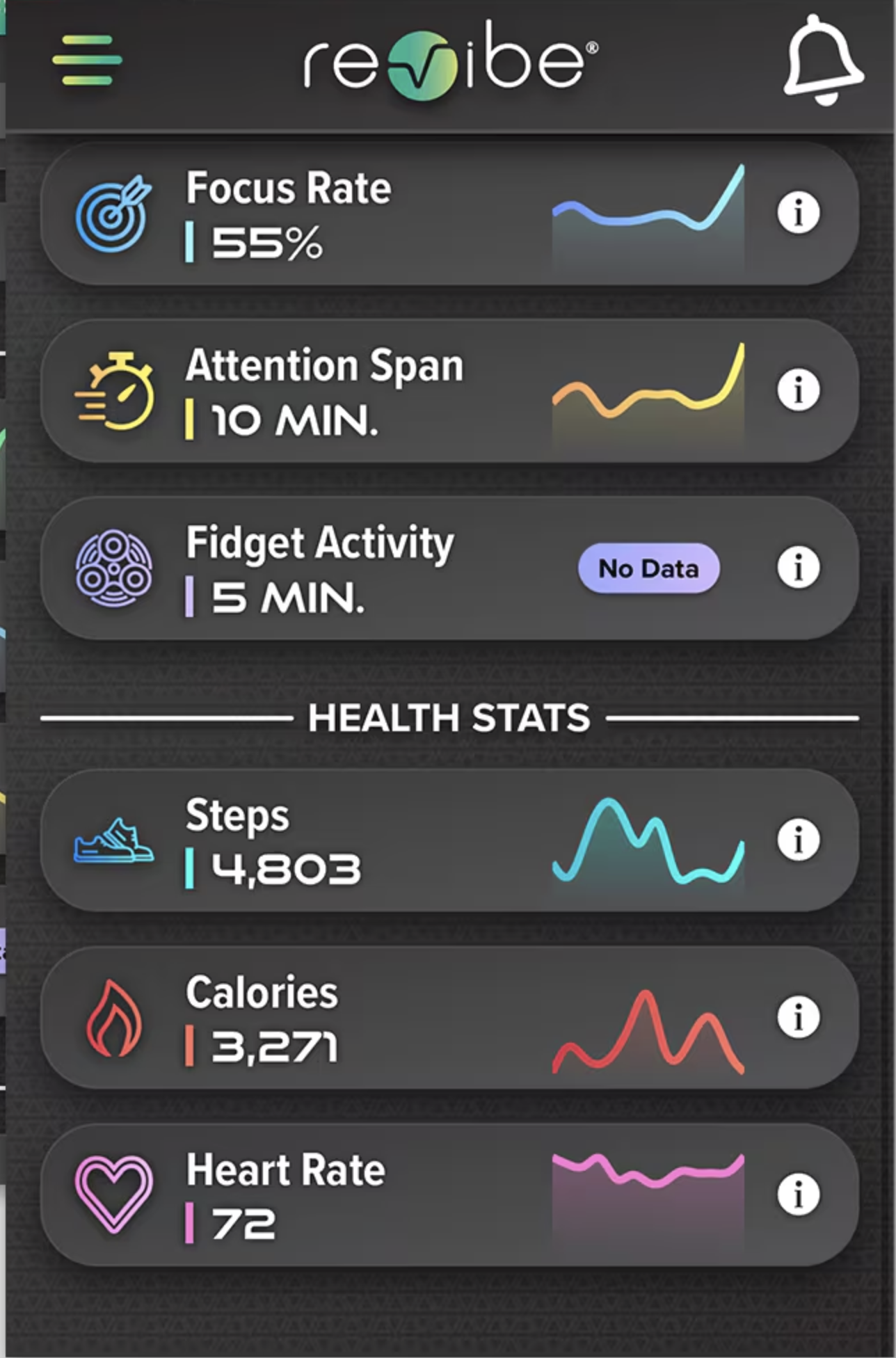
The device was invented by Rich Brancaccio, a school psychologist, and developed by his company, Revibe Technologies. Pearson, the education and assessment company, bought it in 2024 and relaunched it in 2025 on a locked-down Samsung Galaxy Watch that can’t do anything else, and Pearson reports that nearly all schools accept it. The watch learns when a child tends to drift and adjusts how often it buzzes, typically 50 to 60 times a school day. It also delivers scheduled text reminders and an on-wrist checklist, and it collects data (focus rate, attention span, fidgeting, steps, heart rate, and emotional check-ins) that parents, teachers, and clinicians can view in a web app. Revibe is not FDA cleared.
Who is this best for?
Revibe is best for children and teens with ADHD, especially the inattentive type, who drift off task during class or homework without realizing it: the student staring out the window, doodling, or reading the wrong page while looking busy. It also helps kids with executive functioning challenges who forget steps, lose track of time, or leave tasks half-finished, because its reminders and checklist hold that information for them. It works best when a parent and teacher can cooperate, since the watch has to be charged, worn, scheduled for class time, and checked. School psychologists and clinicians may find its data useful for tracking IEP or 504 goals. It is a poorer fit for kids whose main problem is hyperactivity or defiance, and for kids who can’t stand the feel of a vibrating watch.
Why Revibe helps
Psychologist Russell Barkley, one of the most cited ADHD researchers, has long argued that help has to arrive at the “point of performance,” the moment and place where the problem happens. A parent’s reminder at breakfast does nothing for a child who drifts off during third-period math. Revibe puts the reminder in third-period math, quietly, without a teacher calling the child’s name in front of classmates. In a 2023 open-label study published in Brain Sciences, 38 unmedicated children ages 8 to 12 with ADHD wore Revibe to school for four weeks. Parents reported large improvements in inattention (an effect size of 1.07, where 0.8 counts as large) and moderate improvements in hyperactivity. Teachers saw moderate improvements in attention and academic productivity but no significant change in hyperactivity. Revibe was built to target attention, and that is where the gains were clearest. Pearson reports that two blinded studies of 161 children comparing Revibe with a sham device replicated these results, but those studies haven’t been published in a peer-reviewed journal. All of the research so far was funded by the company.How to use Revibe for ADHD
- Schedule prompts for work time only. In the web app, set the watch to buzz during class and homework, and turn it off for lunch, recess, and free time. Buzzing during recess teaches kids to ignore the buzz.
- Practice at home first. Before the first school day, run a few homework sessions with the watch so the child knows what the buzz means and how to answer.
- Make honest answers safe. If a child admits being off task and gets in trouble for it, they’ll start tapping “on task” every time and the data becomes useless. Praise the honest answer. Noticing is the skill.
- Bring the teacher in early. Send a short note explaining what the watch does and that it has no games, texting, or internet. Ask the teacher to glance at the data once a week.
- Build charging into the bedtime routine. In the published study, only 63 percent of the children who started wore the watch often enough to be included, partly because devices weren’t charged or synced. Keep the charger next to the backpack.
- Test the app’s insights before acting on them. If the app says focus is higher on days with more morning steps, try a walk before school for two weeks and see whether the pattern holds.
- Talk with the child’s prescriber. The study children weren’t taking medication, and Revibe hasn’t been tested as a replacement for it. A clinician can help decide where it fits in the treatment plan.
Why Revibe helps
Executive functions are the brain’s management system: the skills that start a task, hold steps in mind, track time, and get things finished. Many kids know exactly what they need to do and still forget to do it at the right moment. Revibe acts as an external memory on the wrist. Parents or teachers can schedule text reminders (“Turn in your reading log,” “Pack your gym clothes”) to appear at set times, and an on-wrist checklist sorts tasks into Unfinished, Snoozed, Coming Up, and Completed. The child still has to do the task. The watch makes sure they think of it when it matters.
The research supports this use. In the 2023 Brain Sciences study, parents reported large improvements in all nine areas of executive function measured by a standard rating scale, with the biggest gains in working memory, getting started on tasks, and organization. Teachers saw a large improvement in self-monitoring and moderate gains in most other areas, though not in emotional regulation or impulse control.
How to use Revibe for Executive Functioning Challenges
- Start with three to five reminders a day. Too many and they turn into background noise. Pick the moments that cause the most trouble, like packing up at the end of the school day.
- Write reminders as actions. “Put homework folder in backpack” works better than “Homework!”
- Let the child help write them. Kids follow reminders they had a hand in creating, and deciding what goes on the list is planning practice.
- Review the checklist together each night. Five minutes looking at what got done and what got snoozed builds the habit of checking a list, which is the long-term goal.
- Use the time-of-day data. If attention span drops after lunch, that is useful information for scheduling homework or asking a teacher about seating or movement breaks.
- Plan for the tool to stay. Using a reminder system is the skill worth building, and it can move to a phone or calendar as the child gets older.
Limitations and Things to Watch For
- Cost and commitment. Plans cost $399 to $449 a year, and the watch stops working without an active subscription. After the 30-day trial window, families are committed for the full 12 or 24 months. A lost watch costs $249 to replace, and failing to return it at the end costs $129.
- The research is early. The one published efficacy study had no control group, its authors worked for or advised Revibe, and parents reported much bigger gains than teachers did. The sham-controlled trials Pearson cites haven’t been peer reviewed. Because Revibe was developed as an ADHD treatment, families should weigh that gap.
- It takes upkeep. The watch has to be charged and synced nightly, scheduled for class time, and worn every school day. In the published study, only 7 percent of kids wore it on all 20 school days.
- Some kids won’t tolerate the buzz. One family in the study withdrew because the vibration bothered their child. The strength can be turned down, but children with tactile sensitivities may still find it hard to wear.
- The focus data is self-reported. A child who taps “on task” to make the buzzing stop will produce rosy numbers. Treat the data as one source of information, alongside what parents and teachers see.
- Revibe uses AI. Pearson’s algorithms adjust the timing of prompts and generate “insights” that link things like steps or fidgeting to focus. These patterns are correlations, not proof of cause, so test them before reorganizing a child’s day around them. Revibe has no chatbot or generative AI features.
- Privacy. The watch collects heart rate, movement, emotional check-ins, and task data, and it is designed to share that data with schools and clinicians. Before setup, decide who gets access, and ask the school how long it keeps the data.
- No games, internet, or mature content. The watch does one job, which is why schools accept it.
Bottom Line
Revibe takes a classroom strategy with decades of evidence behind it, self-monitoring, and makes it practical: a quiet buzz on the wrist instead of a teacher calling out a name. For children with ADHD who drift off task without noticing, and for kids with executive functioning challenges who need reminders at the right moment, it is a well-designed option. Early research found meaningful improvements in attention, working memory, organization, and teacher-rated academic productivity over four weeks, though that evidence is company-funded and not yet confirmed by published controlled trials. It also comes with real costs: roughly $400 a year, a one- or two-year commitment, nightly charging, and a teacher who has to be on board. Families and schools who can handle that upkeep, and who treat honest self-monitoring as the skill rather than chasing a high focus score, have the best chance of seeing results. Use the 30-day guarantee to find out whether the child will wear it and respond to it before the subscription locks in.










Join our Newsletter!
Related Articles