
Overview
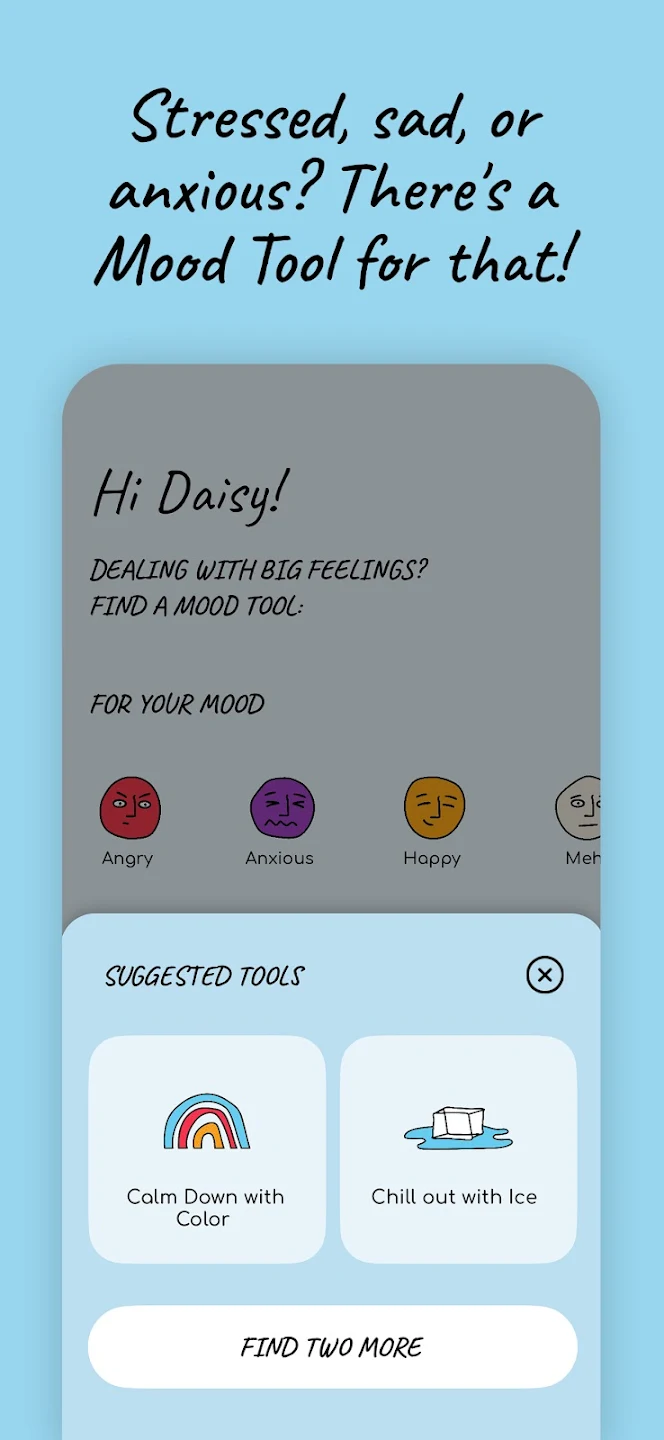
Mood Tools, developed by MOOD, LLC, is a free mental health app for tweens and teens ages 9–17, offering 50+ evidence-based coping tools drawn from CBT, DBT, and ACT. Built for immediacy rather than scheduled sessions, it lets a child in the middle of a meltdown or a surge of anxiety find a useful tool within seconds.
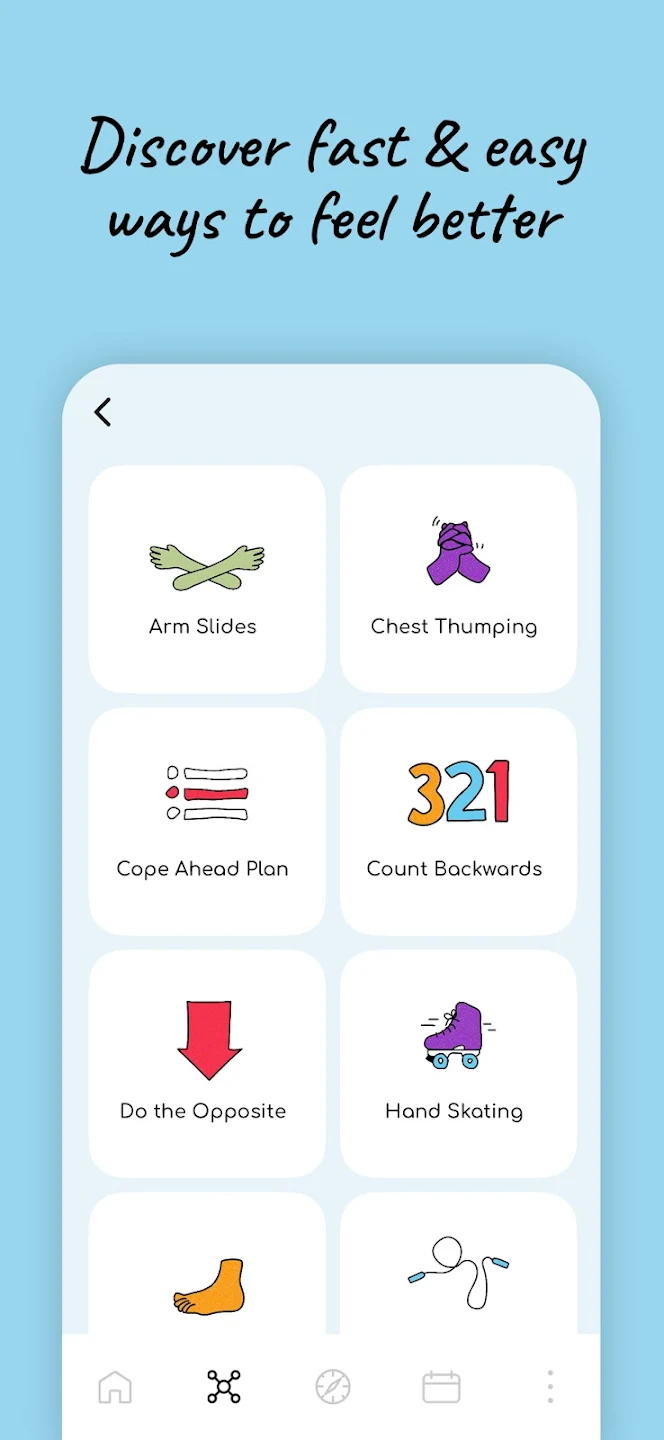
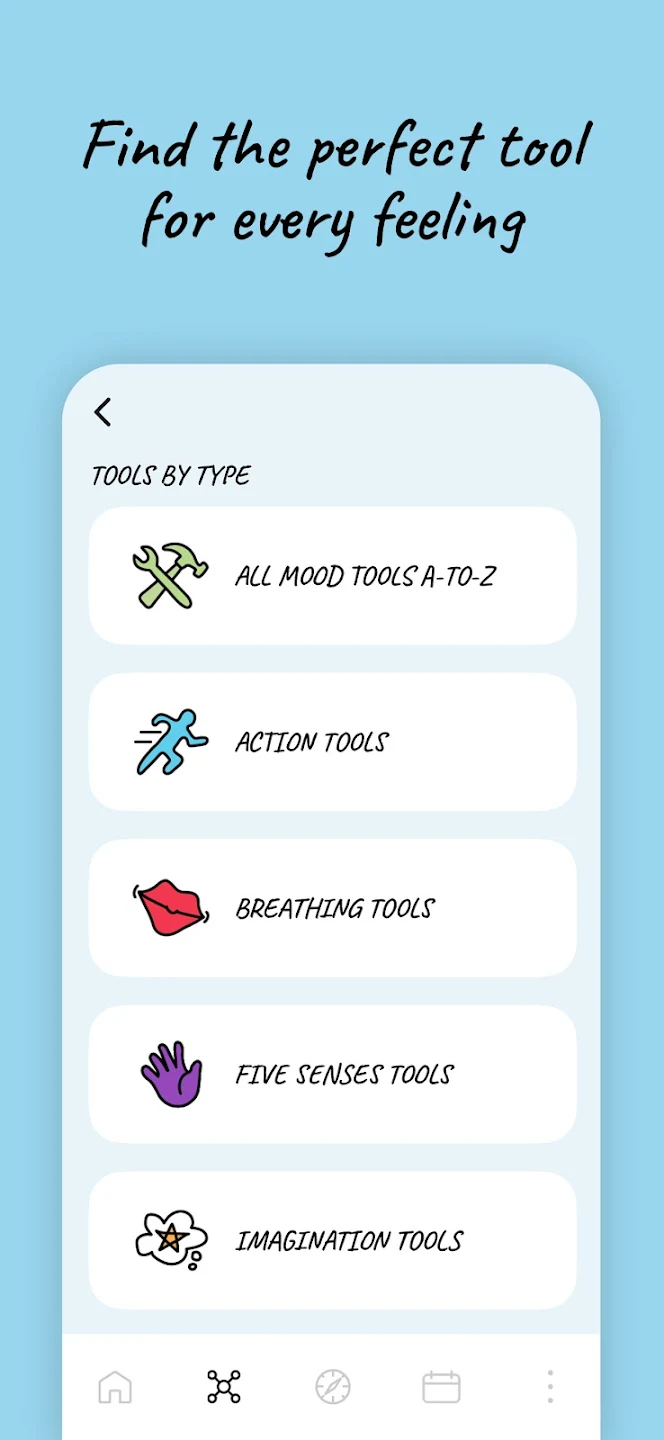
Kids can navigate by mood, physical body cues, or situation. Tools span breathing exercises, grounding techniques, sensory resets, movement strategies, and guided animations — most taking one to two minutes. An “Explore Your Mood” feature helps younger users name what they’re feeling, while a mood journal and calendar support pattern recognition over time.
There are no sign-ups, no ads, no in-app purchases, and no data tracking. Co-created with child psychiatrists, educators, and real teens, the app meets kids where they are without lecturing or talking down to them.
Who is this best for?
The Mood Tools App is an excellent fit for tweens and teens who experience anxiety, big emotional swings, low mood, or stress-related meltdowns — and who need quick, in-the-moment coping tools rather than a long structured program. It works equally well as a self-directed tool for more independent teens and as a caregiver-guided resource for younger or more support-dependent children. Educators will find it particularly useful as a classroom reset tool. It is not a substitute for therapy, but it makes evidence-based coping strategies immediately accessible whenever they are needed.
ADHD
Why The Mood Tools App helps
Children with ADHD often struggle not just with attention and impulse control, but with emotional dysregulation — the difficulty of managing intense feelings quickly and appropriately. Research suggests that emotional dysregulation affects the majority of children with ADHD and is one of the most disruptive aspects of the condition in social and academic settings. A child with ADHD may go from calm to overwhelmed rapidly, and when that happens, they typically need a short, concrete, immediately accessible tool — not a 20-minute therapy exercise. The Mood Tools App is well-suited to this need precisely because it is designed for speed and simplicity. Most tools take under two minutes. The navigation is intuitive and low-friction. A child who is already dysregulated does not have to read lengthy instructions or navigate a complex menu — they can tap their current mood and receive a matching tool almost instantly. Movement-based and sensory tools are particularly relevant for ADHD children, whose nervous systems often respond well to physical engagement as a regulation strategy. The daily mood tracking and badge reward system also align with how many ADHD brains are motivated: through immediate, concrete positive feedback rather than abstract long-term goals.How to use it with an ADHD lens
- Pre-load a shortlist. Help the child identify 2–3 tools that work well for them when they’re calm, and save these to their favorites. When dysregulation hits, having a pre-selected shortlist removes the decision-making burden that can make overwhelmed ADHD brains freeze.
- Use movement tools first. For hyperactive-type presentations, start with body-based tools (movement strategies, fidget-type exercises) before moving to more cognitively demanding tools like journaling.
- Use the body cues filter. Many children with ADHD recognize physical sensations before they can name an emotion. Navigating by body cue (“fidgety,” “racing heart”) may be more accessible than choosing an emotional label.
- Pair with a daily check-in routine. Encourage a brief daily mood log at a consistent time (e.g., after school) to build self-monitoring as a habit. The badge system rewards consistency in a way that resonates with many ADHD learners.
- Keep sessions brief. One tool used fully is more effective than three tools started and abandoned. Encourage the child to complete one tool before deciding whether to try another.
Autism Spectrum Disorder (ASD)
Why The Mood Tools App helps
Many autistic children experience significant difficulty with emotional identification and regulation — a cluster of challenges sometimes described as alexithymia, or difficulty naming and understanding one’s own internal emotional states. When a child cannot easily identify what they are feeling, they cannot access the coping strategies that require emotional awareness as a starting point. This is one reason why autistic children may escalate to a meltdown before anyone (including themselves) fully recognized the distress building beforehand. The Mood Tools App addresses this in a particularly useful way through its multiple navigation pathways. A child who cannot identify their emotion can instead select by body cues (“tight chest,” “fidgety,” “heavy”) or by situation (“school stress,” “something feels off”) and still arrive at an appropriate coping tool. The “Explore Your Mood” feature supports emotional vocabulary building in a low-pressure, non-verbal-heavy format. Over time, this kind of structured, repeated emotional check-in can help autistic children build greater self-awareness of their internal states. Sensory regulation tools are also directly relevant. Many autistic children experience sensory overload or dysregulation as a major trigger for emotional distress, and the app’s inclusion of sensory reset tools provides a concrete, quickly accessible response to those moments. The app’s clean, low-clutter design and the absence of ads or pop-ups also make it a calmer sensory experience than many apps.ASD-friendly ways to use it
- Use the body cues and situation filters. These navigation options lower the barrier for children who struggle to identify or label emotions. Identifying a physical feeling or a situational context is often more accessible than selecting an emotional word.
- Build a personalized tool menu in advance. Work with the child during a calm period to explore and save 3–4 tools that feel comfortable and effective. Familiarity with the tools before a crisis reduces the cognitive demand of using them in the moment.
- Use the mood journal for pattern recognition. The mood calendar can help caregivers and clinicians identify patterns (e.g., consistent distress on certain days or at certain times) that the child themselves may not have connected. This data can inform support planning and IEP or treatment goals.
- Preview tools together. Some autistic children are more willing to try a new coping strategy if they have seen it demonstrated or tried it once with a trusted adult first. Explore tools together proactively rather than introducing them for the first time during distress.
- Respect sensory preferences. Some tools involve sound, music, or visual animation. Give the child control over whether audio is on or off, and let them skip tools that feel overstimulating. The large library means there are always alternatives.
Anxiety
Why The Mood Tools App helps
Anxiety in children and adolescents often manifests as physical arousal (racing heart, shallow breathing, muscle tension) paired with cognitive patterns like catastrophizing, avoidance, and heightened threat sensitivity. When the nervous system is in a heightened state, a child’s capacity to think flexibly, access rational thought, or remember what their therapist told them is significantly reduced. What they can do is follow a simple, sensory, or physical prompt.
This is precisely where The Mood Tools App excels for anxious children. The app’s breathing exercises, grounding tools, and body-based strategies are specifically designed to reduce physiological arousal quickly — the first step in any anxiety response before more cognitive strategies become accessible. Tools like box breathing, the 5-4-3-2-1 grounding technique, and guided visualizations are drawn from CBT and DBT evidence bases and have strong research support for reducing acute anxiety.
The app’s “discreet use” quality is also meaningful for anxious teens. Many adolescents are acutely self-conscious about being seen as struggling, and they will not use a coping tool that draws attention to them in public. The fact that these tools can be used silently on a phone — without anyone around them knowing — significantly increases the likelihood that an anxious child will actually reach for the app when they need it.
Supporting an anxious child with The Mood Tools App
- Start with breathing and grounding tools. These address the physiological component of anxiety first. A child whose nervous system has calmed slightly is far more able to use journaling or cognitive tools afterward.
- Encourage discreet use at school. Let the child know that most tools can be used quietly on their phone without anyone noticing. This reduces the social anxiety that might otherwise prevent them from using the app when they need it most.
- Use “Explore Your Mood” as a check-in ritual. A brief daily mood check-in can help anxious children build the habit of noticing how they feel before reaching a crisis point. Early self-awareness is one of the most effective long-term anxiety management skills.
- Pair with existing therapeutic goals. If a child is in therapy for anxiety, work with their clinician to identify which tools align with their treatment approach. Using the same strategies in the app that they practice in sessions increases consistency and reinforces skills.
- Avoid forcing the journal during acute anxiety. Journaling is most useful for anxious children during or after calm periods, not at peak distress. In the moment, physical and sensory tools are more appropriate first-line responses.
Depression
Why The Mood Tools App helps
Depression in children and teens is often characterized by low motivation, anhedonia (reduced ability to feel pleasure), fatigue, and a pervasive sense that nothing will help. These symptoms create a significant barrier to using any coping tool, including therapy. A child in a depressive episode is not likely to initiate a complex or effortful activity — but they may be willing to tap open an app and try something that takes 90 seconds.
The Mood Tools App supports a principle central to behavioral therapy for depression called behavioral activation — the idea that engaging in small, low-barrier activities can gradually shift mood even when motivation is absent. The app makes this as easy as possible: the child just needs to open it, select their mood, and try one tool. The action of trying something — especially something that results in even a small positive physical sensation, like slowed breathing or a moment of distraction through movement — can interrupt the inertia that depression creates.
The mood journal is particularly valuable for depressed children, who may struggle to communicate verbally about how they are feeling. Writing briefly in the journal — even a sentence or two — externalizes emotional experience in a low-stakes way and creates a record that can be useful in therapy. The mood calendar also helps caregivers and clinicians see patterns in the child’s emotional state over time, since depressed children often have difficulty accurately describing how they’ve been feeling across days or weeks.
Supporting a depressed child with The Mood Tools App
- Lower the bar completely. The goal on hard days is simply to open the app and try one tool. Even if the child closes it after 30 seconds, they made an active choice to engage with their wellbeing. Acknowledge that.
- Choose tools with physical components first. Movement-based and sensory tools require less cognitive effort than journaling or reflection tools, and they address the physical heaviness of depression directly. Starting there lowers the barrier to engagement.
- Use the mood log as a clinical data point. Share the mood calendar with the child’s therapist or clinician. The longitudinal record of logged moods is more reliable than a depressed child’s subjective recall and can inform treatment adjustments.
- Don’t pressure the journal. Journaling can be very helpful for depression, but only when the child is willing. On low-energy days, even a one-word mood log is enough. Normalize partial engagement rather than expecting complete sessions.
- Use it between sessions. The app is especially useful for filling the gap between therapy sessions. Consistent daily use — even if brief — maintains engagement with coping skills and gives the child something to report on at their next session.
Limitations and Things to Watch For
The Mood Tools App is a well-designed, genuinely accessible resource, but caregivers and clinicians should be aware of the following before or during use:
- This is an in-the-moment tool, not a structured program. The app excels at providing immediate coping support but does not offer a progressive learning sequence or skill-building curriculum. Children who need structured, sequential skill instruction (as in a formal DBT or CBT program) will benefit more from a clinician-guided approach, with the app used as a supplement.
- Engagement may be inconsistent without adult support. Younger children and those with more significant executive function challenges may need a caregiver or teacher to prompt app use, particularly at the start. The app does not yet include push notifications or reminders to check in, so building a consistent routine requires external scaffolding.
- Some tools require literacy. While many tools are visual, sensory, or movement-based, the journal and some text-heavy tools assume reading ability. Children who are not fluent readers may need support navigating those features.
- The app does not replace clinical support. The Mood Tools App is a coping tool supplement, not a treatment. For children with diagnosed anxiety, depression, ADHD, or autism, it should be used alongside — not instead of — professional support. Caregivers working with a clinician are encouraged to share the app with them so its use can be integrated into therapeutic goals.
- Mood data is self-reported. The mood log reflects what a child chooses to record, which may not capture the full picture — particularly for children who minimize distress or who have difficulty accurately identifying their emotional states. Use the mood calendar as a useful data point, not a definitive clinical measure.
Bottom Line
The Mood Tools App stands out for its breadth of evidence-based tools, its genuinely accessible design, and its ability to meet children exactly where they are — in the middle of a hard moment, on their phone. For neurodivergent children who struggle with emotional regulation and self-awareness, it provides an immediate, low-pressure way to practice coping skills that would otherwise only be available in a therapy session. Used consistently alongside caregiver support and clinical care, it is one of the more practical and child-friendly emotional wellness tools available.
Related Guides









Join our Newsletter!
Related Articles